

Cross-border data transfers create serious challenges for cloud privacy, especially when laws from different regions conflict. For example, the U.S. CLOUD Act mandates data access for law enforcement, even if stored abroad, while countries like Brazil and Argentina enforce strict data transfer limits. This clash leaves businesses navigating complex legal landscapes and compliance risks.
Key points:
- Regulatory conflicts: U.S. laws like the CLOUD Act often contradict GDPR or LATAM frameworks, creating compliance dilemmas.
- Data localization: Countries like Brazil and Argentina require strong safeguards for international transfers, increasing operational costs.
- Privacy risks: Cross-border transfers expose data to government access, jurisdictional conflicts, and cybersecurity vulnerabilities.
- Compliance tools: Mechanisms like Standard Contractual Clauses (SCCs) and Binding Corporate Rules (BCRs) help manage transfers but require thorough documentation and assessments.
- Emerging trends: Data sovereignty laws and localization requirements are growing, while automated compliance tools are becoming essential.
To manage these challenges, businesses must combine legal safeguards, technical solutions like encryption, and real-time compliance tracking. The stakes are high, with fines reaching up to €20 million or 4% of global revenue for non-compliance.
Data in Transit: Cross-Border Challenges for Security and Privacy
sbb-itb-edfb666
Regulations Governing Cross-Border Data Transfers
LATAM vs U.S. Data Privacy Frameworks Comparison Chart
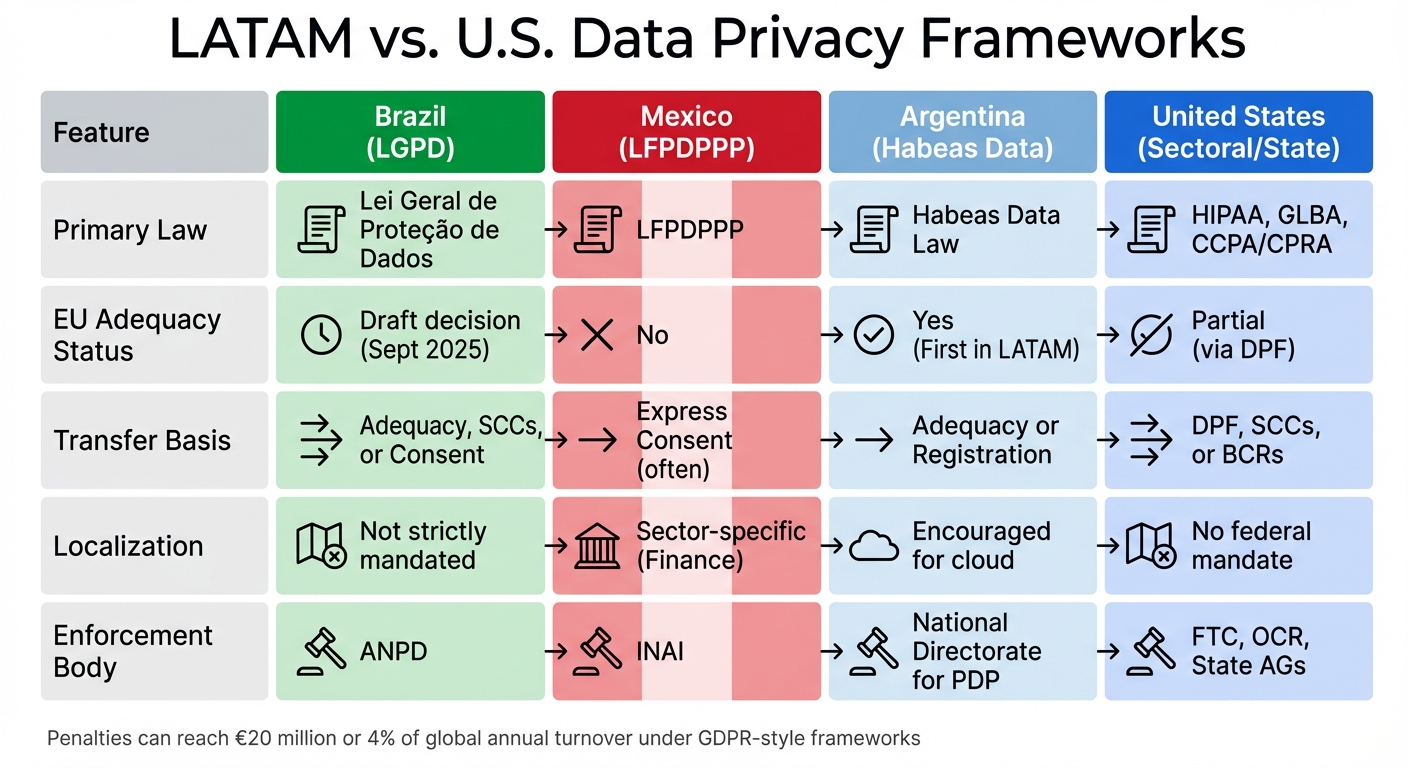
The U.S. and Latin America take distinctly different approaches to cross-border data transfer regulations. In the U.S., rules are sector-specific, like HIPAA for healthcare and GLBA for finance. There’s no overarching federal privacy law governing all data transfers. Latin America, on the other hand, leans toward unified, GDPR-inspired frameworks. Many countries in the region have established centralized data protection authorities to enforce comprehensive national rules.
LATAM Privacy Laws
Brazil’s Lei Geral de Proteção de Dados (LGPD) doesn’t strictly require data localization but insists that international transfers meet "adequate" protection standards. Transfers can be based on user consent, contractual obligations, or other legal grounds. In August 2024, Brazil’s national data protection authority (ANPD) introduced an International Data Transfer Regulation mandating the use of Standard Contractual Clauses (SCCs). Zac Soto from PAG Law explained:
Brazilian SCCs… must be adopted in full and with no changes to the text as set forth in the International Data Transfer Regulation.
Mexico’s Federal Law on Protection of Personal Data Held by Private Parties (LFPDPPP) requires notifying users about international transfers, often requiring express consent. Certain sectors, like finance and telecommunications, may also face stricter localization rules. Argentina, which was the first LATAM country to achieve EU adequacy status under its Habeas Data Law, emphasizes database registration and transparency in data handling practices.
In contrast, the U.S. relies on a sector-specific model, which differs significantly from the unified frameworks seen in LATAM.
U.S. Data Transfer Regulations
The U.S. CLOUD Act allows law enforcement to access data, regardless of its storage location. For transatlantic transfers, the EU-U.S. Data Privacy Framework (DPF), adopted in July 2023, allows certified U.S. companies to receive EU personal data on an adequacy basis. By early 2026, over 3,000 U.S. companies had self-certified under the DPF. Additionally, the U.S. Department of Justice introduced the Data Security Program (DSP) on October 6, 2025, under 28 C.F.R. Part 202. This program limits the transfer of "bulk sensitive personal data" to specific countries, including China, Russia, and Iran.
State-level laws, such as California’s CCPA/CPRA, add another layer of complexity, requiring risk assessments for sensitive data transfers and imposing additional compliance obligations.
LATAM vs. U.S. Data Privacy Frameworks
Here’s a comparison of the key differences between the regulatory approaches in LATAM and the U.S.:
| Feature | Brazil (LGPD) | Mexico (LFPDPPP) | Argentina (Habeas Data) | United States (Sectoral/State) |
|---|---|---|---|---|
| Primary Law | Lei Geral de Proteção de Dados | LFPDPPP | Habeas Data Law | HIPAA, GLBA, CCPA/CPRA |
| EU Adequacy Status | Draft decision (Sept 2025) | No | Yes (First in LATAM) | Partial (via DPF) |
| Transfer Basis | Adequacy, SCCs, or Consent | Express Consent (often) | Adequacy or Registration | DPF, SCCs, or BCRs |
| Localization | Not strictly mandated | Sector-specific (Finance) | Encouraged for cloud | No federal mandate |
| Enforcement Body | ANPD | INAI | National Directorate for PDP | FTC, OCR, State AGs |
LATAM countries generally enforce privacy through centralized data protection authorities, while the U.S. relies on a fragmented system involving agencies like the FTC, HHS, and state Attorneys General. GDPR-style frameworks in LATAM allow for penalties of up to €20 million or 4% of global annual turnover. For instance, Ireland’s Data Protection Commissioner fined Meta’s Instagram €405 million (around $403 million) in September 2022 for violations related to children’s data.
These differences highlight the importance of understanding regional regulations when managing cloud privacy risks and compliance strategies. They also frame the operational challenges organizations face when dealing with cross-border data transfers.
Privacy Risks in Cross-Border Cloud Systems
Cross-border data transfers bring heightened privacy challenges, as they expose data to conflicting regulatory environments. Navigating these risks is crucial for ensuring compliance and safeguarding sensitive information.
Government Access and Jurisdictional Conflicts
The U.S. CLOUD Act (18 U.S.C. § 2713) requires U.S.-based cloud providers to disclose stored data, no matter where it resides. This can conflict with laws like GDPR Article 48, which restricts data transfers based on unsolicited court orders. For example, if a company uses Amazon Web Services or Microsoft Azure, it must comply with U.S. government requests, even if the data is stored in Brazil or Mexico.
This creates a significant dilemma for businesses. U.S. law demands disclosure, while laws in Europe or Latin America may explicitly prohibit such transfers.
Adding to the complexity, U.S. surveillance laws like Section 702 of the Foreign Intelligence Surveillance Act (FISA) and Executive Order 12333 allow broad access to communications data. European courts have criticized these laws, citing them as incompatible with privacy rights. This incompatibility has already led to the invalidation of frameworks like Safe Harbor and Privacy Shield.
These jurisdictional conflicts make compliance even more challenging, especially with the rise of data sovereignty laws.
Data Sovereignty and Localization Requirements
Data sovereignty means that data is subject to the laws of the country where it is stored. This poses logistical hurdles for businesses operating in multiple regions. For instance, Brazil’s LGPD and Argentina’s Habeas Data Law require international transfers to occur only with jurisdictions that provide "adequate" protection or through specific legal safeguards like Standard Contractual Clauses.
Global data localization laws add another layer of complexity. Companies are often required to maintain separate local infrastructures, which increases costs and operational risks. China’s Personal Information Protection Law (PIPL), for example, mandates strict government security reviews for cross-border transfers involving large-scale or sensitive personal data.
These localization requirements force companies to abandon centralized cloud architectures in favor of redundant local systems. This approach not only complicates operations but also introduces new security risks during data segregation. In Mexico, industries like finance and telecommunications face particularly stringent residency rules, adding to the challenge.
This fragmented approach to data handling can lead to increased vulnerabilities in decentralized, cross-border cloud systems.
Cybersecurity Threats in Cloud Environments
Cross-border data transfers also heighten the risk of breaches, phishing attacks, and ransomware. Localization laws often require companies to set up multiple regional data centers, each with its own security measures, access controls, and monitoring systems. This decentralization increases the attack surface, making it easier for cybercriminals to exploit gaps.
Additionally, cloud infrastructures frequently replicate data across borders automatically. For instance, a U.S. company using a cloud setup that replicates data to a European data center might unknowingly trigger a cross-border transfer, subjecting the data to additional legal requirements.
Some organizations assume that encryption alone resolves these risks. While encryption is a critical security tool, it does not qualify as a legal transfer mechanism under frameworks like the GDPR. Businesses must still establish valid legal grounds, such as adequacy decisions or Standard Contractual Clauses, even when encrypted data is involved.
Following the Schrems II ruling, 47% of organizations reported uncertainty about their ability to ensure adequate data protection, while 11% admitted they lacked clarity on compliance requirements. This uncertainty leaves companies exposed to fines and security vulnerabilities as they navigate the complexities of cross-border data management.
Compliance Strategies for Cross-Border Data Transfers
Navigating compliance for cross-border data transfers involves a mix of legal frameworks and technical measures to safeguard sensitive information across different jurisdictions.
Standard Contractual Clauses and Binding Corporate Rules
Standard Contractual Clauses (SCCs) are pre-approved templates that establish binding agreements for data transfers across four scenarios: controller-to-controller, controller-to-processor, processor-to-controller, and processor-to-processor. These clauses are often used when transferring data to countries without formal adequacy decisions. However, organizations must also complete Transfer Impact Assessments (TIAs) to ensure local surveillance laws don’t compromise the protections offered by SCCs.
Binding Corporate Rules (BCRs) are designed for multinational companies that need to transfer data within their corporate group. These rules require approval from a lead EU supervisory authority and are especially useful for organizations with frequent intra-group data transfers.
For U.S. companies, the EU-U.S. Data Privacy Framework (DPF) offers a streamlined approach. Certified organizations can receive personal data from the EU without additional safeguards, provided they adhere to the framework’s privacy principles. As of late 2023, over 3,000 U.S. companies had self-certified under the DPF.
In Brazil, the National Data Protection Authority introduced a stricter SCC model in 2024. Under this regulation, Brazilian data controllers must provide the full text of contractual instruments used for transfers to data subjects within 15 days if requested.
| Mechanism | Best Use Case | Key Requirement |
|---|---|---|
| Standard Contractual Clauses (SCCs) | General transfers between unrelated parties | Requires a Transfer Impact Assessment |
| Binding Corporate Rules (BCRs) | Intra-group transfers for multinational corporations | Needs approval from a lead EU supervisory authority |
| Data Privacy Framework (DPF) | EU to U.S. transatlantic transfers | Requires self-certification via the International Trade Administration |
These legal tools work hand-in-hand with technical measures to strengthen data protection.
Encryption and Data Privacy Frameworks
Technical measures like encryption add an extra layer of security to cross-border data transfers. While encryption is vital for protecting data both in transit and at rest, it doesn’t replace the need for a valid legal mechanism under laws like the GDPR.
Best practices include separating encryption keys from the data they protect, ensuring that even if data is stored overseas, it remains secure. Combining strong encryption standards with detailed logging and traceability can further enhance security. Additionally, organizations can use technical architectures that separate data and encryption keys across jurisdictions, reducing the risk of unauthorized government access.
The EU-U.S. Data Privacy Framework (DPF) allows U.S. companies to receive EU data without additional safeguards if they meet specific privacy principles. Businesses can verify certifications at dataprivacyframework.gov. The economic fallout from invalidating the previous Privacy Shield framework was estimated to have reduced digital trade by $22–$36 billion. To maintain compliance, companies should automate the documentation of TIA triggers and keep an up-to-date inventory of data flows, including storage locations, access points, and third-party subprocessors.
Kreativa Inc‘s Cross-Border Compliance Support

While legal and technical measures are crucial, operational support on the ground can make or break compliance efforts. Cross-border compliance in Latin America (LATAM) often involves navigating complex labor laws, payroll systems, tax regulations, and HR requirements. For U.S. companies expanding into LATAM without local entities, these challenges can lead to delays and risks of non-compliance.
Kreativa Inc specializes in simplifying these processes. They handle cross-border recruitment, onboarding, payroll, and HR management for teams in Mexico and Argentina. With offices in Chicago and operations across LATAM, Kreativa Inc allows businesses to focus on growth instead of regulatory headaches. By partnering with Kreativa, LATAM teams can cut costs by up to 50% while benefiting from seamless collaboration within U.S. time zones.
For instance, in 2025, real estate company AvantStay built an 18-person Sales Development Representative (SDR) team in Latin America with Kreativa’s help. The team was sourced and onboarded in just 21 days, generating $20 million in additional Annual Recurring Revenue (ARR) through outbound sales within one year.
Future Developments in Cloud Privacy and Cross-Border Data Transfers
As cloud privacy continues to evolve, it’s clear that both technical safeguards and legal frameworks are becoming more sophisticated. Companies relying on outdated compliance models may find themselves at greater risk as regulations tighten and technology advances.
New Technologies for Data Privacy
Technical measures are now as critical as legal agreements when it comes to ensuring data privacy. For example, segregated key management, which keeps encryption keys stored separately from the data, minimizes the risk of foreign government surveillance.
Other tools like pseudonymization and tokenization play a key role in reducing the identifiability of data before it’s transferred across borders. These methods help organizations meet the "essentially equivalent" protection standards demanded by regulators. Additionally, geofencing and integrated policy engines can automatically block data transfers that violate jurisdictional laws.
Automated compliance platforms are also making waves. These systems generate real-time, audit-ready documentation, such as Transfer Impact Assessments (TIAs) and encryption logs, with just a few clicks. This approach, often referred to as compliance-by-design, embeds technical controls directly into cloud infrastructure, making regulatory adherence a built-in feature.
"Compliance is now an interactive, evidence-driven discipline that demands legal, technical, and operational alignment across global data flows." – Melento
With these technological advancements, the landscape of data protection is being redefined. However, legal frameworks are also shifting, adding another layer of complexity.
Changing Regulatory Requirements
Legal challenges are evolving rapidly, often outpacing technological solutions. For instance, on October 6, 2025, the U.S. Department of Justice’s Data Security Program (DSP) officially took effect under 28 C.F.R. Part 202. This program restricts access to "bulk sensitive personal data" by entities tied to six nations: China, Russia, Iran, North Korea, Cuba, and Venezuela.
Meanwhile, the EU-U.S. Data Privacy Framework (DPF), introduced in 2023, is already under scrutiny. Legal challenges could potentially dismantle it, much like the Privacy Shield before it. In September 2025, the General Court of the CJEU ruled in Latombe v. CNIL that national supervisory authorities could opt not to investigate complaints involving frameworks deemed adequate by the European Commission. However, this ruling is currently under appeal.
Global trends in data localization are also accelerating. By 2021, 62 countries had implemented 144 different data-related restrictions, a sharp increase from 35 countries and 67 restrictions in 2017. Nations like Mexico and Argentina are now enforcing stricter localization rules, particularly in sectors like finance and telecommunications. This growing emphasis on localization means organizations must provide real-time, documented technical evidence of compliance – not just rely on signed agreements.
In this uncertain regulatory environment, the move toward automated compliance tools and verifiable technical safeguards is becoming essential for organizations managing global data flows.
Conclusion
Cross-border data transfers come with a maze of legal obligations – from the GDPR’s far-reaching jurisdiction to LATAM’s rapidly changing localization requirements. Non-compliance isn’t just a regulatory headache; it can lead to penalties as high as €20 million or 4% of global annual revenue, posing a serious financial threat.
The days of relying on bare-minimum compliance measures are over. A compliance-by-design approach is now critical. For instance, nearly 47% of organizations admitted to uncertainty about meeting data protection standards after the Schrems II ruling. This highlights a glaring gap between legal mandates and operational readiness. To bridge this gap, technical solutions like segregated key management, pseudonymization, and automated Transfer Impact Assessments (TIAs) have become indispensable.
While these compliance hurdles are daunting, the evolving regulatory landscape also presents opportunities. Take the January 2026 mutual adequacy agreement between the EU and Brazil. This agreement marks a step toward greater alignment in LATAM markets. Meanwhile, the U.S. Department of Justice’s Data Security Program adds another layer of oversight. To adapt, companies must centralize their data inventories, streamline documentation, and brace for increased market surveillance.
Kreativa brings clarity to this complexity. With expertise in cross-border staffing, we simplify HR, payroll, contracts, and compliance across regions like Mexico and Argentina. By aligning workforce management practices with U.S. and LATAM regulations, we help businesses focus on growth while ensuring their data transfers meet strict compliance standards.
As regulations tighten and adequacy frameworks evolve, one thing is clear: treating data privacy as a core operational priority – not just a legal checkbox – will be the key to success. Organizations that emphasize precise implementation, thorough documentation, and ongoing vigilance will be well-positioned to navigate these challenges and thrive.
FAQs
How do I know which country’s laws apply to my cloud data?
The rules that apply to your cloud data are influenced by where it’s collected, processed, stored, and transferred. Regulations from both the country where the data originates and the destination country can come into play, particularly when data crosses borders. To stay compliant, organizations need a solid grasp of both local and international laws. In some cases, legal tools like adequacy decisions or standard contractual clauses might be necessary to handle data residency and sovereignty requirements properly.
What should a Transfer Impact Assessment (TIA) include?
A Transfer Impact Assessment (TIA) focuses on determining if the destination country provides a comparable level of data protection. This involves examining the legal and regulatory framework, identifying potential risks associated with the transfer, and outlining measures to ensure compliance with data protection laws. This is particularly critical when transferring data to non-EEA countries that lack adequacy status.
How can I prevent cross-border transfers caused by cloud replication?
To avoid unintentional cross-border data transfers caused by cloud replication, it’s essential to establish clear agreements with your cloud providers. These agreements should explicitly outline data transfer restrictions and ensure compliance with regulations like GDPR or LATAM-specific laws.
Here are some steps to help maintain control over your data:
- Set Safeguards: Implement measures like binding corporate rules or standard contractual clauses to maintain compliance with international data protection standards.
- Choose the Right Provider: Opt for cloud providers that offer data residency options, allowing you to store data within specific geographic regions.
- Conduct Regular Audits: Periodically review your cloud provider’s compliance and operational practices to ensure adherence to agreed-upon restrictions.
- Use Technical Controls: Employ tools such as encryption, strict access controls, and data localization policies to reduce the risk of unintended data transfers.
By combining these strategies, you can better manage your data within the cloud and stay aligned with legal and regulatory requirements.