
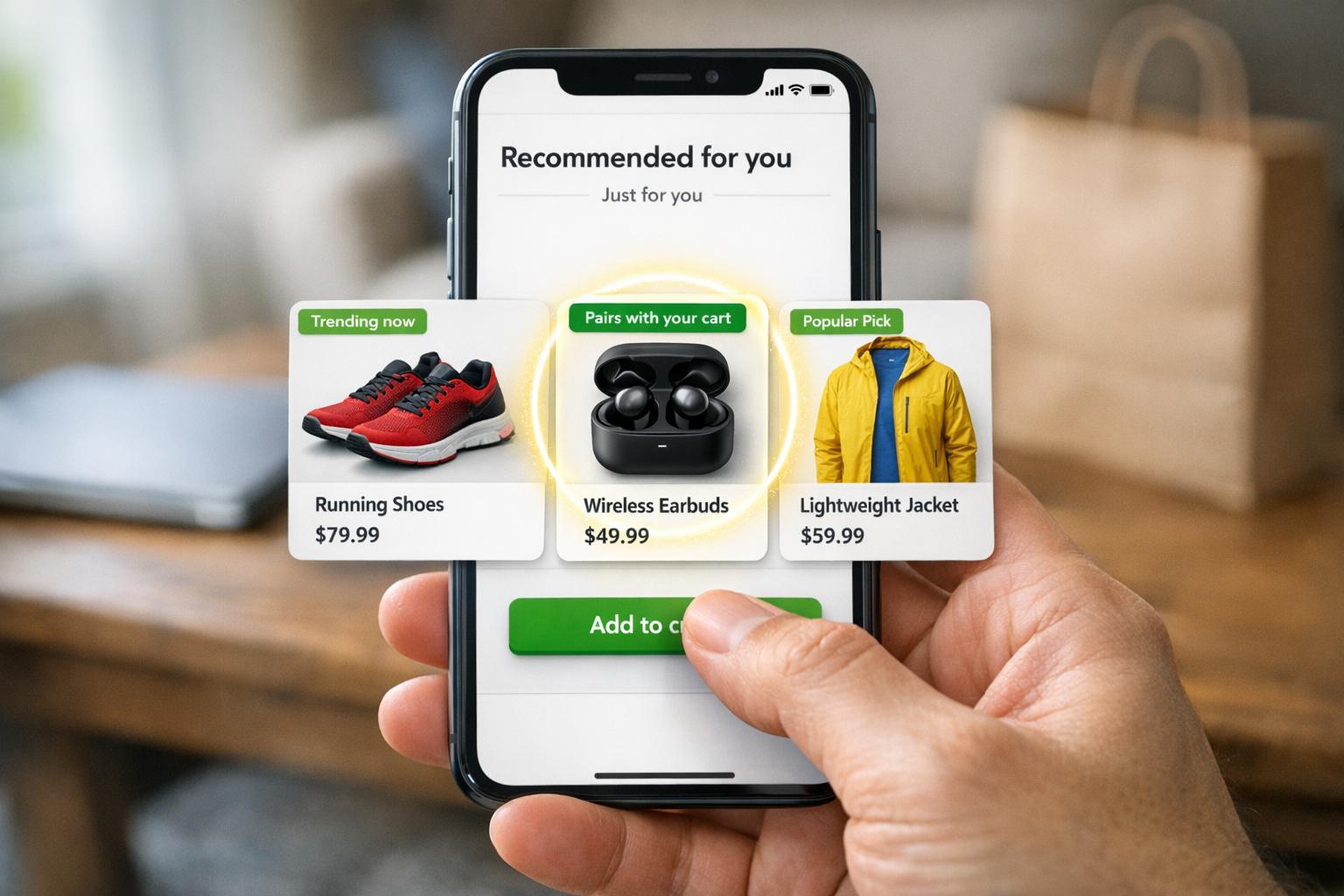
Real-time recommendation systems are transforming online shopping by analyzing customer behavior instantly and tailoring product suggestions to match their current intent. This approach drives higher sales, reduces cart abandonment, and boosts customer loyalty. Key takeaways:
- Why It Matters: Personalization increases sales by up to 20%, and systems like Amazon‘s account for 35% of revenue through recommendations.
- How It Works: AI models analyze live session data (clicks, views, cart additions) to suggest relevant products in milliseconds.
- Proven Results: Shopify’s system improved orders by 0.94% during Black Friday 2025, while Orveon Global saw a 10-15% increase in average order value through hybrid recommendations.
- Future Trends: AI-driven natural language interfaces and AR/VR tools are making shopping more intuitive and engaging.
Real-time personalization is no longer optional – it’s essential for staying competitive in e-commerce. Businesses that implement these systems see improved revenue, higher conversion rates, and stronger customer relationships.
[Use Case] Real-Time Recommendation Systems: Transforming User Experience Through Session-Aware Data
sbb-itb-edfb666
Technologies Behind Real-Time Personalization
Real-time recommendation systems are powered by advanced technologies that work together to analyze customer behavior as it unfolds. These systems are designed to predict what a shopper wants in the moment, using a combination of machine learning models, hybrid system architectures, and infrastructure capable of delivering responses in milliseconds.
Machine Learning Models for Behavioral Analysis
Modern e-commerce platforms leverage cutting-edge machine learning models to understand shopping as a continuous sequence of events rather than isolated actions. For example, Shopify introduced a generative recommender in February 2026 based on the HSTU architecture. This system processes customer actions – like searches, product views, and cart additions – as a sequence to predict the next likely step. It uses autoregressive models with causal masks to make these predictions.
One standout feature of these models is their ability to treat time as a critical signal. By using RoPE-inspired rotary encoding, they capture both absolute timestamps and the time gaps between events. This means identical browsing patterns in different seasons can lead to different recommendations. Ali Khanafer, Senior Staff Machine Learning Engineer at Shopify, explains:
Commerce is context. Browsing history in June and the same browsing history in December should not lead to the same outcome.
These generative models have shown measurable success, improving conversion rates and customer engagement during high-traffic shopping periods.
Hybrid Recommendation Systems
To ensure recommendations are both accurate and commercially effective, many platforms use hybrid architectures. These systems combine content-based filtering (focused on product attributes) with collaborative filtering (focused on shopper behavior). Typically, they use an ensemble approach: retrieval models generate a pool of candidate recommendations, which are then refined by rankers and filtered through aggregation layers to balance diversity and business goals.
Hybrid systems also separate business constraints from personalization. Explicit rules ensure commercial considerations – such as stock levels, profit margins, and supplier agreements – are respected, while machine learning optimizes the ranking for individual users. This approach prevents scenarios that could erode trust, like recommending incompatible or unnecessary add-ons for premium products.
In April 2026, Orveon Global, the parent company of brands like bareMinerals and Laura Mercier, saw a 10%–15% increase in average order value (AOV) after implementing AI-driven hybrid recommendations. Carney Nir, VP of Ecommerce and Site Experience, noted:
Immediately – and this was consistent across every brand – we saw an AOV lift between 10% to 15% for each brand. So I think our ability to cross-sell with Nosto live drove an immediate sales lift.
These hybrid systems are a cornerstone of effective e-commerce strategies, balancing personalization with operational goals.
Real-Time Data Processing vs. Batch Processing
The key distinction between real-time and batch processing lies in how quickly data is acted upon. Batch processing uses historical data and updates recommendations periodically – daily or weekly. Real-time processing, on the other hand, analyzes live behavioral signals, updating recommendations within milliseconds during a session.
| Feature | Batch Processing | Real-Time Processing |
|---|---|---|
| Data Source | Historical logs, static segments | Live session behavior, triggers |
| Update Frequency | Daily, weekly, or per session | Milliseconds (mid-session) |
| Conversion Impact | Baseline | Higher than batch |
| Best Use Case | Long-term affinity, seasonal trends | Cart abandonment, stock-aware offers |
Real-time processing is particularly valuable for dynamic data, like inventory levels and pricing, helping avoid errors such as recommending out-of-stock items. Many systems combine these approaches, using batch processing for durable user preferences and real-time processing for immediate session intent.
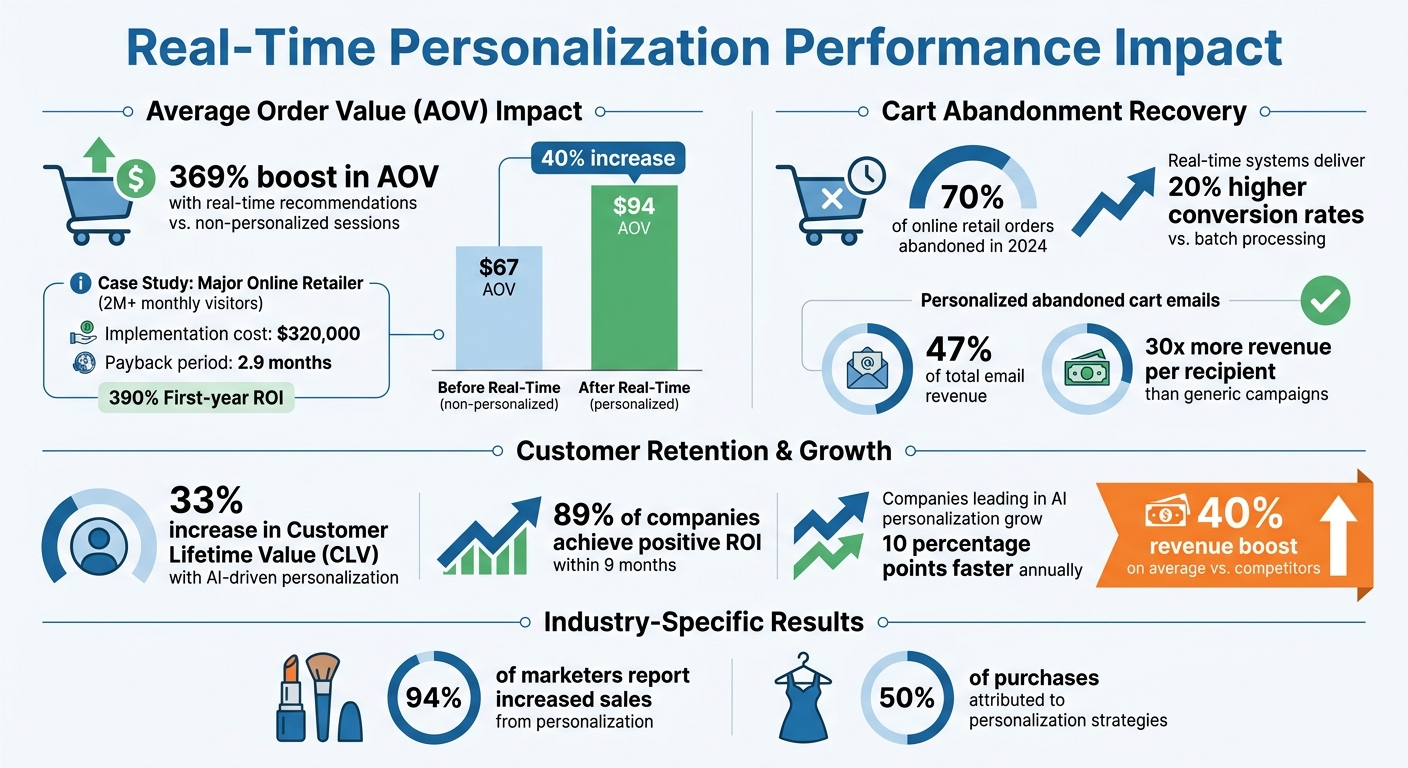
Companies that excel in real-time personalization report significant advantages. On average, they see a 40% revenue boost compared to competitors, with 89% confirming a positive ROI from AI-driven personalization, often within a nine-month payback period.
Impact on E-Commerce Performance Metrics
Real-Time Personalization Impact on E-Commerce Performance Metrics
Real-time recommendation systems are reshaping e-commerce by driving noticeable improvements in key performance metrics. The contrast between personalized and generic shopping experiences becomes evident in areas like revenue, conversion rates, and customer behavior.
Increasing Average Order Value (AOV)
Personalized recommendations can significantly increase the size of customer orders. Sessions featuring real-time recommendations show a 369% boost in Average Order Value (AOV) compared to those without personalized interactions. In fact, a single tailored suggestion has the potential to nearly quadruple AOV.
For example, in November 2024, a major online retailer with over 2 million monthly visitors implemented a deep learning-based recommendation engine to tackle stagnant AOV. Under the leadership of Chief Digital Officer Sarah Kim, the retailer introduced collaborative filtering and real-time personalization across its platform. This effort raised AOV from $67 to $94 – a 40% increase. With a $320,000 implementation cost, the system paid for itself in just 2.9 months and delivered a 390% ROI within the first year. Reflecting on the transformation, Sarah Kim shared:
The AI recommendation system transformed our business overnight. Customers are discovering products they love, purchasing more per order, and coming back more frequently.
These results stem from analyzing customer behavior during sessions – such as clicks, pauses, and product comparisons – to suggest complementary items at the perfect time. Features like cart-page bundles and "frequently bought together" modules take advantage of high-intent moments just before checkout. Additionally, inventory-aware algorithms ensure recommendations highlight in-stock, high-margin products that drive revenue.
Now, let’s look at how these systems help reduce cart abandonment and recover lost sales.
Reducing Cart Abandonment Rates
Real-time personalization plays a crucial role in addressing cart abandonment by responding to customer behavior as it happens. With over 70% of online retail orders abandoned in 2024, minimizing this loss is essential. Real-time systems, which adapt mid-session, deliver conversion rates 20% higher than batch-based approaches.
One effective strategy is personalized abandoned cart emails. These emails, tailored to reflect a customer’s recent browsing activity, account for up to 47% of total email revenue and generate 30 times more revenue per recipient than generic campaigns.
While these tactics recover immediate sales, they also contribute to building long-term customer loyalty.
Improving Customer Retention Through Personalization
Personalized strategies go beyond individual transactions, helping businesses foster long-term relationships with their customers. By anticipating needs and remembering preferences across visits, real-time personalization reduces friction and enhances loyalty. Companies that excel in AI-driven personalization report a 33% increase in Customer Lifetime Value (CLV). Additionally, 89% of these companies achieve a positive ROI, typically within nine months.
The competitive edge is undeniable. Businesses that lead in AI personalization grow about 10 percentage points faster annually compared to those that lag behind.
Case Studies of Successful Implementations
Examples from leading companies show how real-time recommendation systems can create personalized experiences that directly impact growth.
Nike: Bridging Online and Offline Experiences
Nike has successfully integrated real-time recommendations to connect digital and physical retail. By using data like customer location, they create unified profiles that deliver tailored suggestions, whether a customer is shopping online or in-store. This seamless approach reduces friction between channels and increases conversions.
Other major retailers are also using real-time personalization to improve product discovery and customer engagement.
Sephora: AI-Powered Beauty Recommendations
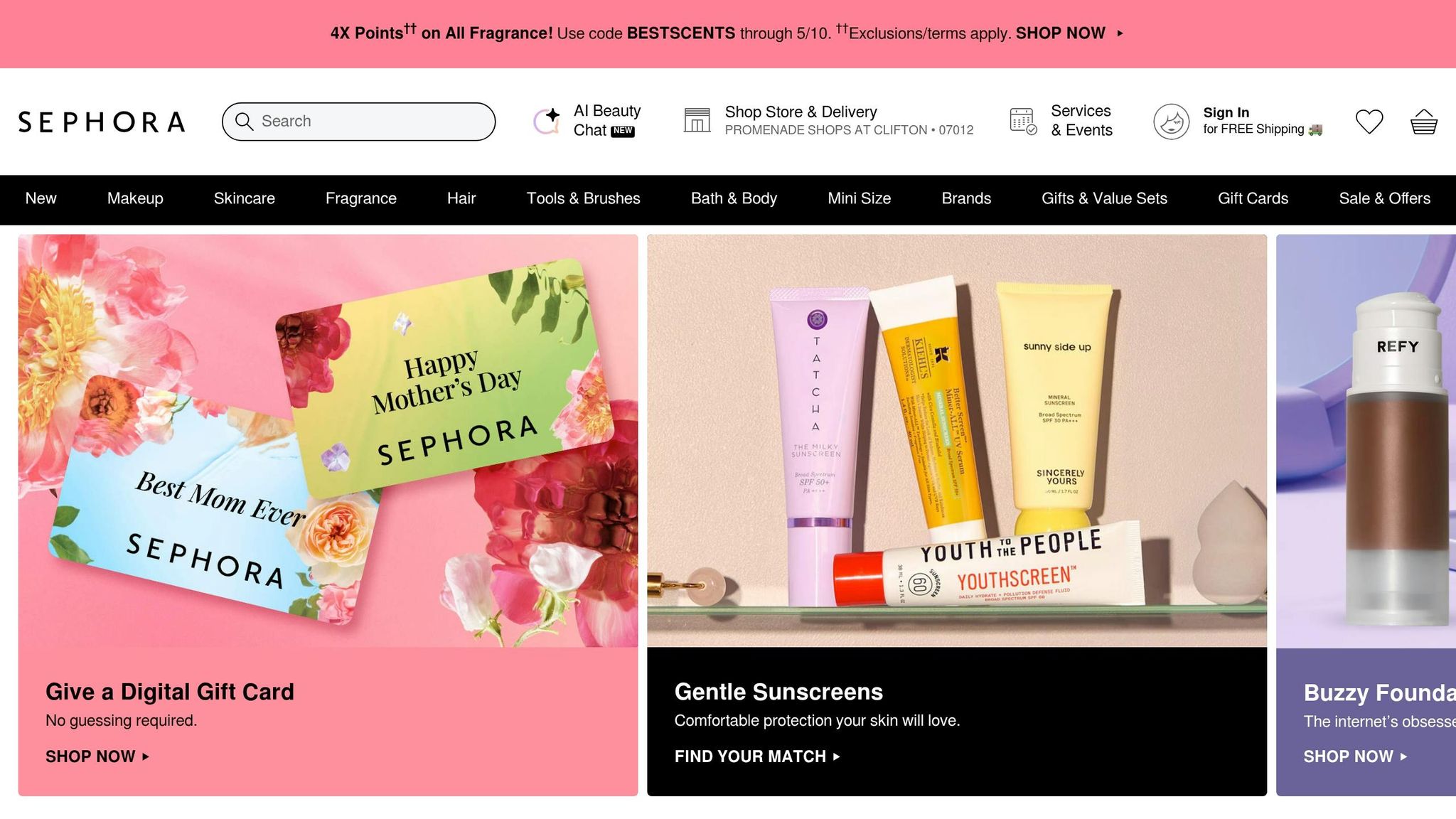
In March 2026, Sephora introduced a ChatGPT-powered app designed to transform how customers discover beauty products. Spearheaded by Global Chief Digital Officer Anca Marola and North America GM of e-Commerce Nadine Graham, the app allows Sephora’s 80 million Beauty Insider members to link loyalty accounts for real-time recommendations based on their purchase history, preferences, and rewards. Customers can ask natural language questions like, "What’s the best foundation for dry skin?" and instantly receive tailored product suggestions from Sephora’s catalog. The company plans to roll out the feature globally and add in-app checkout functionality.
Nadine Graham highlighted the initiative’s goals:
By blending our digital retailer expertise with new AI tools, we are creating new seamless and conversational experiences that are not only efficient but helpful for beauty consumers.
Similarly, companies like Alibaba are leveraging real-time personalization to meet the demands of massive global markets.
Alibaba: Scaling Personalization for Global E-Commerce

Alibaba has taken real-time personalization to a new level by focusing on sequential journey modeling. This approach views customer behavior as a series of interconnected actions – like searches, product views, and cart additions. Using generative recommender architectures (HSTU), Alibaba processes raw event sequences while ensuring ultra-low latency in production environments. This allows the company to maintain high engagement levels across its vast global user base, demonstrating how real-time systems can drive meaningful results in e-commerce at scale.
Future Trends in Real-Time Recommendation Systems
While today’s systems have already made a big impact on conversions and average order value (AOV), the future holds even more potential for creating personalized and smarter customer interactions. The next wave of recommendation systems is moving beyond simple product matching, offering new ways for e-commerce businesses to connect with customers in real time.
Agentic AI and Natural Language Interfaces
Recommendation technologies are evolving to bring a more conversational and intuitive feel to customer interactions. One of the key developments is the shift from traditional product ID systems to semantic IDs, which represent products as sequences of tokens. This allows systems to process both product data and natural language simultaneously, making the experience feel more human-like and engaging.
These advancements also enable prompt-based adaptations, allowing systems to incorporate richer input signals like text queries or assistant interactions. For instance, instead of just analyzing clicks or past purchases, a system could interpret a query such as, “What’s the best laptop for video editing under $1,500?” and deliver recommendations tailored to the user’s intent.
Shopify showcased this shift in February 2026 with its generative recommender, which treats buyer journeys as sequences. This approach not only improves recommendation performance but also enhances training efficiency. By the same year, it’s anticipated that AI will manage 100% of customer service interactions, with agentic systems capable of understanding and responding through natural language.
AR/VR Integration for Immersive Shopping Experiences
Augmented reality (AR) and virtual reality (VR) are opening up exciting possibilities for real-time personalization. In fashion, technologies like visual similarity matching (commonly referred to as "Shop the look") and AI-driven size and fit prediction are transforming how customers shop. In beauty and cosmetics, AI is being used for shade matching and skin type analysis, creating highly tailored recommendations.
The results speak for themselves: 94% of beauty and cosmetics marketers report increased sales due to personalization, and fashion brands attribute 50% of their purchases to these strategies. These immersive tools reduce the guesswork for customers, allowing them to see how products will look or fit before making a purchase. Additionally, multimodal embeddings – which align text and image data – are improving the relevance of visual searches and product retrieval.
As AR and VR continue to enhance customer interactions, real-time analytics are refining in-session personalization by capturing even the smallest details of user behavior.
In-Session Personalization and Real-Time Analytics
One of the most exciting trends is the ability to interpret user intent during a session. Modern systems are moving away from static audience segments to focus on live behavior interpretation, where every action – whether it’s a pause, a revisit, or a comparison – is processed and analyzed within milliseconds.
To make this possible, these systems rely on robust infrastructures capable of handling massive amounts of real-time data. They use time-aware attention mechanisms to account for factors like gaps in activity, recency, and seasonality without needing manual adjustments.
The payoff is clear. Real-time personalization delivers conversion rates that are 20% higher than traditional batch processing, and companies leading in personalization grow about 10 percentage points faster than their competitors each year. However, achieving these results requires signal hygiene – ensuring that product IDs are consistent, identities are stitched accurately across devices, and event tracking is complete. Without these foundational elements, even the most advanced models can fall short.
Conclusion: Growth Through Real-Time Personalization
Real-time recommendation systems have become a must-have for e-commerce businesses aiming to grow faster. These systems can drive growth rates up by 10 percentage points and deliver a positive ROI in just nine months.
The benefits of real-time personalization are clear: it can increase conversion rates by 20% and boost average order value (AOV) by an incredible 369%. Plus, it helps recover revenue often lost to high cart abandonment rates.
But success hinges on doing it right. Start by ensuring signal hygiene – this means having clean event tracking and consistent product IDs. Focus on high-intent placements, like cart page bundles, to see immediate results. These steps help align your strategy with the technology.
With live intent interpretation responding in milliseconds and low-code tools making implementation easier for mid-sized companies, real-time personalization is more accessible than ever. And with 80% of consumers preferring tailored experiences, the cost of standing still is far too high.
FAQs
What data do I need to run real-time recommendations?
To deliver real-time recommendations, you’ll need customer behavior data – things like searches, product views, items added to carts, and purchases. On top of that, incorporating contextual signals and historical data can make your recommendations more precise and relevant to users.
How do I measure ROI from real-time personalization?
To gauge the ROI of real-time personalization, focus on tracking a few essential metrics. Start by measuring conversion rates, average order value (AOV), and customer retention both before and after introducing personalized recommendations. Compare sales data with and without personalization to assess the incremental revenue generated.
Additionally, pay attention to changes in cart abandonment rates and repeat visits – these can signal enhanced customer experiences and stronger loyalty. Pairing these quantitative metrics with qualitative feedback will give you a clearer picture of how well your efforts align with overall business objectives.
What’s the simplest way to start without rebuilding my stack?
The easiest way to bring real-time recommendations into your setup without a complete system overhaul is by adding a real-time personalization layer. This layer works with your current system, analyzing live user actions – like clicks or searches – to deliver instant recommendations. By leveraging APIs or SDKs, you can roll out these modules step by step, reducing disruption while quickly benefiting from personalized, real-time insights.