
AI is transforming how businesses handle social media crises. It monitors platforms like X, TikTok, and Reddit to identify potential issues before they escalate into full-blown PR disasters. By analyzing spikes in mentions, shifts in sentiment, and unusual engagement patterns, AI can flag problems within minutes – far faster than manual methods. Companies using AI report up to a 70% reduction in crisis damage compared to traditional approaches.
Key Takeaways:
- Speed: AI detects crises in under 5 minutes by analyzing data trends.
- Signals Monitored: Sudden spikes in mentions, negative sentiment, and rapid content sharing.
- Sources: Social media posts, hashtags, influencer activity, and news mentions.
- Methods: Natural Language Processing (NLP) for tone detection and anomaly detection for unusual activity.
- Workflow: Automated severity scoring and human review ensure accurate and timely responses.
AI doesn’t just react – it predicts. By identifying early warning signs, it gives teams the chance to act quickly and minimize reputational risks.
AI & NLP for Social Media Analytics, Misinformation Detection, and Proactive Crisis Management Title
sbb-itb-edfb666
Key Signals AI Monitors for Crisis Detection
AI doesn’t just track issues – it interprets them, distinguishing between positive viral moments and potential PR nightmares. By analyzing specific indicators, it ensures every potential threat is assessed with precision and timeliness.
Sudden Spikes in Mentions
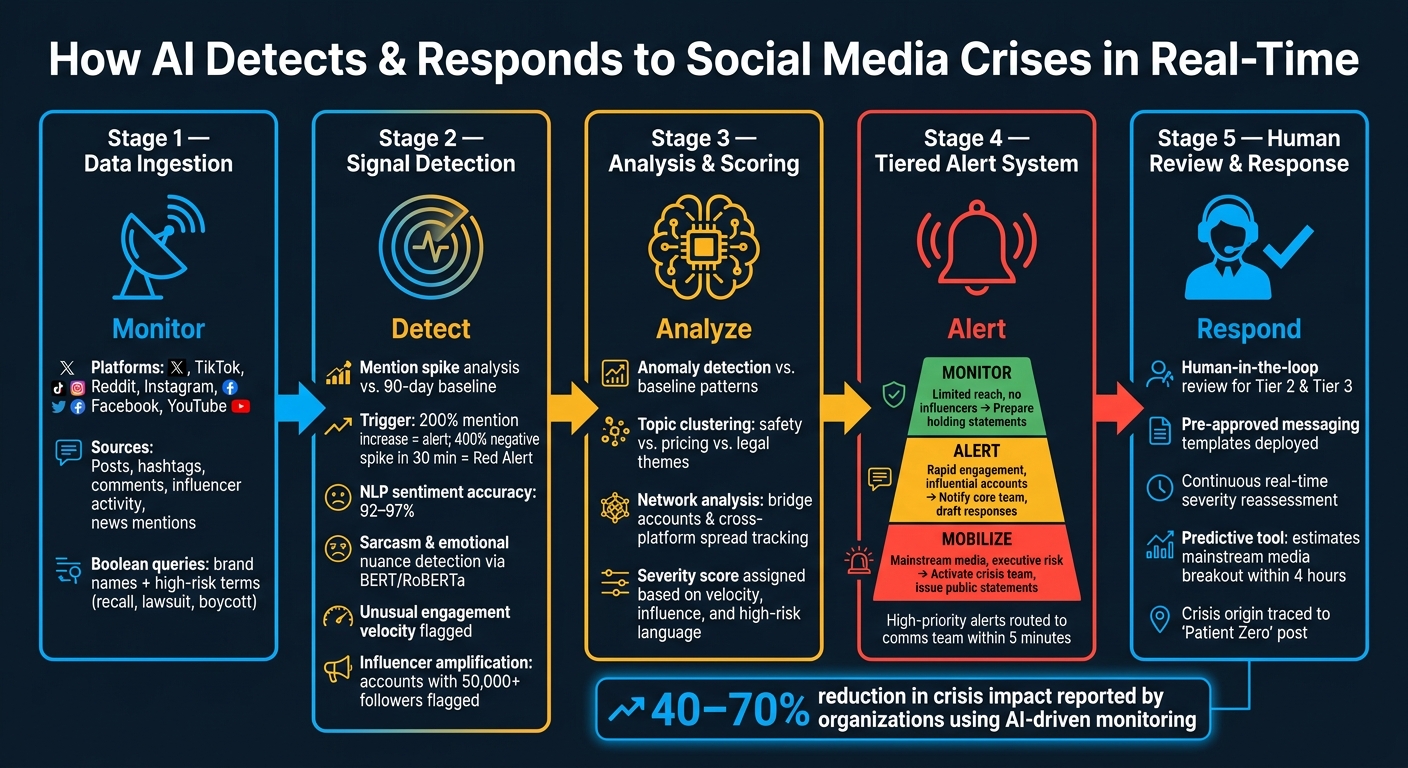
AI doesn’t merely count mentions. Instead, it analyzes the rate of change in mentions against a 90-day historical baseline. For example, a 200% increase in mention volume is a reliable indicator of unusual activity. For enterprise-level brands, a 400% jump in negative mentions within just 30 minutes triggers a "Red Alert". This rapid threshold analysis is a cornerstone of AI’s ability to spot threats before they spiral out of control.
Negative Sentiment Shifts
Raw volume of mentions can be misleading – what matters is why people are talking. A surge in mentions might celebrate a product launch, but it could also signal growing dissatisfaction. This is where AI pairs volume tracking with sentiment analysis to uncover deeper insights.
Natural Language Processing (NLP) models go beyond basic positive/negative categorization. They identify subtleties like mild disappointment or intense anger and even detect sarcasm in posts that seem positive on the surface. With sentiment classification accuracy ranging from 92–97%, AI provides a reliable emotional context for mentions.
"Before we integrated AI sentiment analysis, we relied on ‘gut feeling’ to determine if a bad tweet was a minor annoyance or a full-blown crisis. Now, the data tells us exactly when to wake the CEO up at 2 AM, and more importantly, when to tell them to go back to sleep because the trend is already decaying." – The Yuktis Team
While sentiment analysis uncovers emotional tone, engagement patterns reveal how far and fast the issue is spreading.
Unusual Engagement Patterns
AI doesn’t stop at mentions and sentiment – it also tracks how users engage with content. When a post garners shares and comments at an unusually rapid pace, even with low overall numbers, it signals that the content might be gaining "escape velocity".
The source of amplification is just as critical. AI flags posts shared by verified accounts, influential journalists, or users with over 50,000 followers, as their reach can quickly elevate a story to mainstream attention. Interestingly, many crises show detectable social signals 2 to 4 hours before traditional media picks them up. This underscores the importance of AI’s real-time, integrated monitoring for early intervention.
Data Sources AI Systems Use
AI systems rely on a variety of data sources to piece together a detailed picture of a crisis. While identifying what to monitor is important, understanding where to gather that information is just as critical. The quality and scope of these sources directly influence the accuracy of AI’s crisis assessment.
Social Media Posts and Hashtags
Platforms like X (formerly Twitter), Reddit, Instagram, TikTok, Facebook, and YouTube are treasure troves of information for AI systems. By using boolean queries that combine brand names with high-risk terms (such as "recall", "lawsuit", or "dangerous"), AI can sift through massive amounts of content to identify genuine early warning signs.
When new hashtags tied to a specific incident suddenly appear – especially if they weren’t active a day earlier – AI flags this as a potential "amplification phase." This phase indicates that conversations surrounding the issue are beginning to gain momentum and organize.
Comments, Replies, and Influencer Activity
AI doesn’t stop at scanning posts; it dives deeper into comments and replies, where frustrations and concerns often surface first. Using natural language processing (NLP), AI clusters these comments into themes (e.g., pricing concerns vs. safety issues), helping teams quickly identify which narratives are gaining traction.
Influencer activity is monitored with extra attention. Through influence mapping, AI can distinguish between a random complaint from an anonymous user and the same issue raised by a verified journalist or an activist with a large following. It also tracks "connector accounts", users who act as bridges between niche communities and mainstream audiences. These accounts can play a pivotal role in pushing a story from a small forum into a widespread public conversation.
News Mentions and Cross-Platform Monitoring
When content stays confined to a single platform, it’s easier to manage. However, when it starts spreading across platforms – like moving from Reddit to X to TikTok – it signals a more serious escalation. AI tracks this cross-platform spread as a key escalation indicator.
Additionally, traditional news sources are integrated into the monitoring process. When an issue that started on social media begins appearing in mainstream news outlets, AI flags it as a "mainstream breakout" event. This is a clear signal that the situation has moved beyond online chatter and into broader public awareness. By combining social media data with news mentions, AI provides teams with a unified view of the crisis, eliminating the inefficiency of platform-by-platform monitoring. This streamlined approach can save significant time, reducing the daily review workload from 8–12 hours to just 20–40 minutes.
"AI combines language understanding, topic clustering, and anomaly detection to separate noise from signals… turning chaotic feeds into clear actions." – The Pedowitz Group
AI Methods Used for Real-Time Crisis Detection
Interpreting data is as critical as identifying it. Below, we explore how AI transforms raw social data into actionable insights through advanced methodologies.
Natural Language Processing (NLP)
NLP adds depth to the signals mentioned earlier by providing crucial context. Unlike basic keyword detection, modern NLP systems can interpret tone, understand sarcasm, and detect emotional nuances that simpler filters would miss.
What sets today’s NLP apart is its ability to classify intent. For instance, instead of merely tagging a post as "negative", advanced models can determine if someone is voicing a complaint, issuing a legal threat, or signaling dissatisfaction that might lead to them cutting ties with a brand. Transformer-based models like BERT and RoBERTa make this level of contextual understanding possible at scale.
Anomaly Detection
A high volume of mentions doesn’t necessarily indicate a crisis. Velocity – how quickly mentions or negative sentiment accelerate – is a far more telling metric.
AI systems establish a baseline by analyzing typical engagement patterns over a period, often 90 days. When current activity exceeds this baseline significantly – such as a 200% increase – an alert is triggered, ensuring high-priority issues reach communication teams swiftly.
"The absolute number matters less than the deviation from baseline. Effective detection systems track normal patterns and alert on anomalies – sudden spikes in volume, unusual engagement rates, or atypical sentiment distributions." – Xpoz
This method also helps filter out routine noise. For example, spikes caused by product launches or viral campaigns can resemble crises in raw data. By factoring in organizational context – like planned campaigns or earnings announcements – AI can distinguish between routine activity and genuine threats.
Topic Clustering and Network Analysis
After detecting an anomaly, AI must determine what people are discussing and how those conversations are spreading. This is where topic clustering and network analysis come into play.
Topic clustering organizes posts and comments into distinct themes, such as separating safety concerns from pricing complaints. This allows teams to identify specific narratives that require immediate attention. Network analysis, on the other hand, maps how these narratives spread, tracking their journey from initial posts to influential accounts.
AI also monitors "bridge accounts" – users who connect niche groups to broader audiences. These accounts often signal when a localized issue has the potential to escalate. By combining this with cross-platform tracking, teams gain a clearer understanding of whether a conversation is contained or likely to go mainstream. This layered analysis gives teams the tools they need to act quickly and effectively.
"Crises spread through networks. Understanding how content moves from initial posting through increasingly influential accounts reveals amplification patterns." – Xpoz
From Detection to Action: Alerts and Response Workflow
How AI Detects & Responds to Social Media Crises in Real-Time
Detection is just the beginning; the real game-changer lies in how quickly and effectively alerts are managed. With real-time detection as a foundation, AI takes it further by turning these signals into actionable alerts through a well-structured workflow.
Severity Scoring and Confidence Thresholds
Not every spike in activity demands the same level of attention. AI assigns severity scores by analyzing several factors: the speed at which negative mentions are increasing, the influence of the accounts amplifying the content, and the presence of high-risk language such as "lawsuit", "recall", or "boycott."
Instead of simply repeating detection, severity scoring converts these insights into tiered responses. High-priority alerts are routed to the communications team – often within five minutes – complete with all the essential context, such as the source and spread of the issue. Here’s an example of how tiered frameworks typically guide actions:
| Response Tier | Trigger Signals | Action Required |
|---|---|---|
| Tier 1: Monitor | Negative content with limited reach and no influential amplifiers | Prepare holding statements; no immediate public action |
| Tier 2: Alert | Rapid engagement or unusual activity from influential accounts | Notify the core team; draft potential responses |
| Tier 3: Mobilize | Widespread impact, mainstream media attention, or executive-level risks | Activate the crisis team; issue public statements |
Once the severity is scored, human reviewers step in to fine-tune the priorities and ensure the response aligns with the situation.
Escalation and Human Review
While AI excels at speed and data processing, human oversight is crucial for interpreting context – especially for Tier 2 and Tier 3 alerts. Automated systems can miss nuances like sarcasm, niche community jokes, or industry-specific slang, which could lead to either overreaction or underreaction. To address this, most workflows include a human-in-the-loop review to handle these edge cases without delaying the response.
Pre-approved messaging templates tailored to specific alert scenarios also help streamline the process. Once a human reviewer confirms the situation, these templates allow teams to respond quickly and confidently.
Continuous Monitoring and Updates
Crises are rarely static; they evolve over time. Building on earlier methods like anomaly detection and topic clustering, continuous monitoring ensures teams stay updated as trends shift. AI reassesses severity in real-time, adjusting alert statuses as negative sentiment either escalates or begins to subside.
Predictive tools estimate the likelihood of mainstream media attention within four hours, based on current engagement trends. This supports the early intervention strategies discussed earlier in this guide. Additionally, AI can trace the origin of a crisis back to its first post or thread – often referred to as "Patient Zero" – giving teams a clear understanding of the root cause rather than just addressing the symptoms. Organizations leveraging AI-driven monitoring have reported a 40–70% reduction in crisis impact compared to their previous methods.
Conclusion: What AI Means for Crisis Management Going Forward
AI-driven monitoring is reshaping crisis management by cutting down oversight time and reducing reputational risks. This advancement allows brands to act faster than ever to protect their public image.
What makes AI truly impactful is its ability to shift crisis management from being reactive to being predictive. By keeping a constant watch on social media and other platforms, AI helps organizations address potential issues before they escalate. As Xpoz.ai aptly states:
"Early detection doesn’t guarantee successful crisis management, but late detection guarantees limited options."
This highlights the critical role of AI in identifying early warning signs. The period between noticing these signs and the story gaining traction in mainstream media is where AI proves its worth. Once a crisis goes viral, the options for controlling the narrative narrow significantly.
That said, AI isn’t here to replace human expertise – it works alongside it. While AI excels at quickly analyzing vast amounts of data, identifying trends, and flagging potential crises, it still depends on skilled professionals to interpret the findings, shape the right response, and make strategic decisions. The best outcomes come from teams that combine AI’s capabilities with human insight.
"The most effective crisis management strategies will combine AI’s efficiency with human strategic thinking." – Pressmaster.ai
For organizations still relying on outdated crisis management methods, adopting AI is no longer optional – it’s essential. By late 2025, adoption among PR professionals has surged from under 30% in 2022 to over 60%. Those who embrace AI tools today will gain a critical edge, enabling them to handle future crises with agility and precision. In doing so, they ensure they’re prepared for the challenges ahead.
FAQs
How does AI tell a real crisis from a viral trend?
AI can tell the difference between a real crisis and a passing viral trend by analyzing social media activity in real time. It looks at posts, comments, and mentions to spot spikes in activity, shifts in sentiment, or recurring themes. Viral trends often show high engagement levels, but AI identifies crises when there’s a surge in negative sentiment or concerning content. This allows organizations to act quickly and address real threats instead of wasting energy on short-lived trends.
What data does AI use to catch a crisis early?
AI helps spot potential social media crises by monitoring real-time signals like mentions, comments, and posts on platforms such as Twitter and Instagram. It looks for unusual surges in activity or noticeable changes in sentiment. Using filtering techniques, it separates everyday conversations from real risks. By defining what "normal" activity looks like, AI can quickly identify anything out of the ordinary, giving organizations the chance to act swiftly before situations spiral out of control.
How do teams combine AI alerts with human review?
Teams leverage AI tools to keep an eye on social media activity in real-time, spotting potential crises by examining shifts in sentiment, trending topics, or unexpected patterns. When the AI detects something concerning, it triggers alerts that highlight the severity and relevance of the issue. From there, human reviewers step in to confirm the findings, understand the context, and decide on the best course of action. This combination of AI’s speed and human insight allows for quick, precise crisis management while cutting down on unnecessary false alarms.