
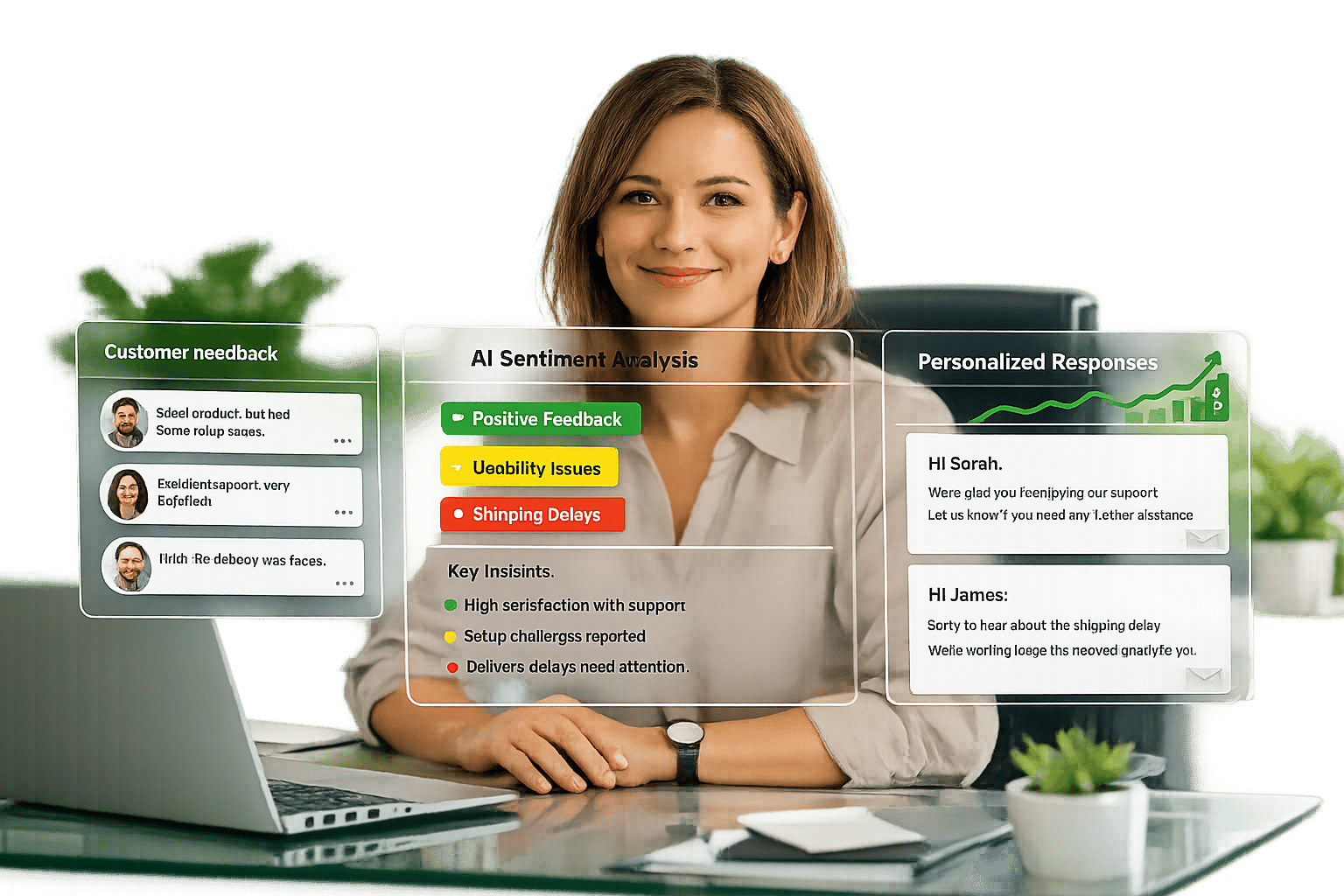
Feedback automation simplifies how businesses collect, analyze, and act on customer feedback. It uses AI and event-based triggers to gather insights in real time, helping companies improve customer retention and reduce churn. Why does this matter? Here are the key takeaways:
- Retention boosts profits: A 5% increase in retention can raise profits by 25% to 95%.
- Customer expectations are rising: 71% of consumers want personalized interactions, and 30% will leave if they feel ignored.
- Retention is cost-effective: Customer acquisition costs have soared by 222% over eight years, making it more economical to retain existing customers.
- Automation delivers results: Companies using feedback automation grow revenue 41% faster than competitors.
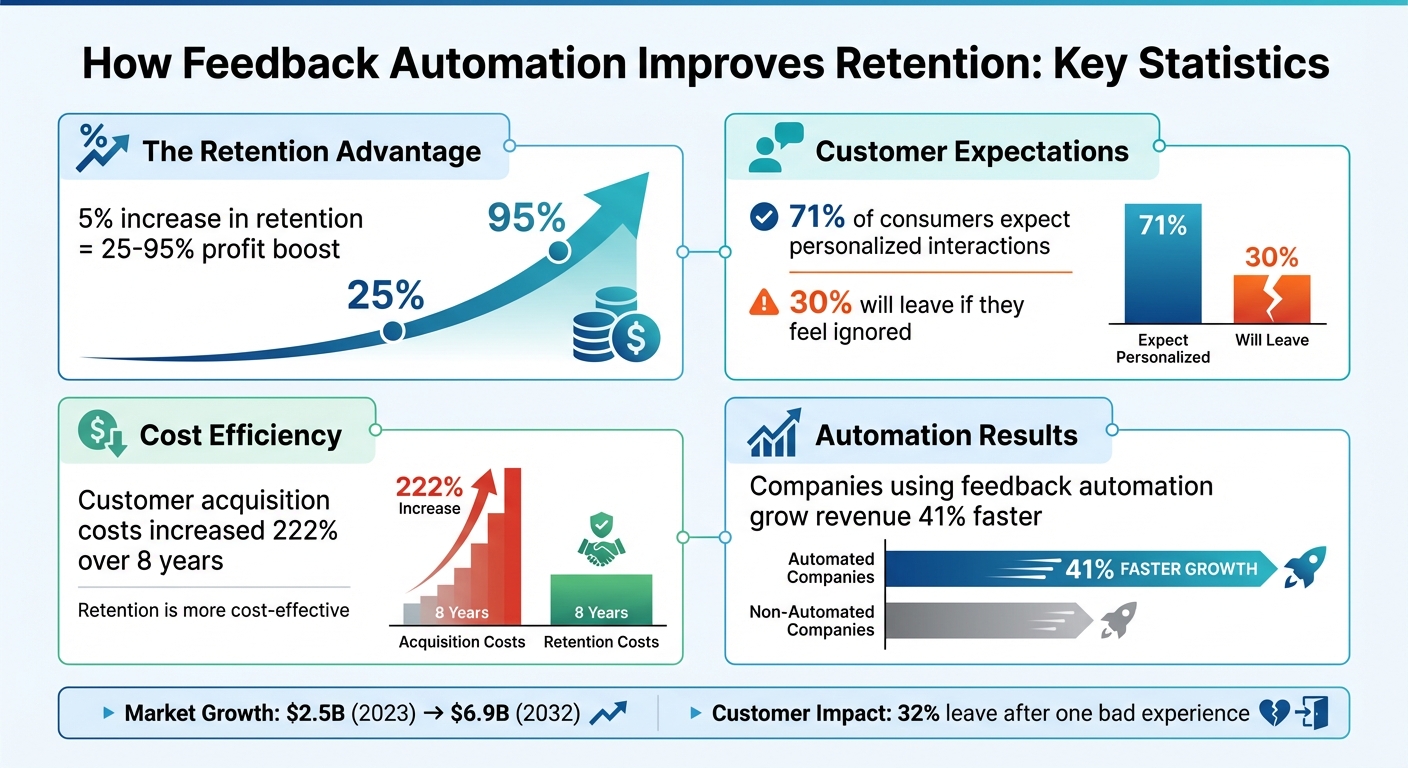
Key Statistics: How Feedback Automation Improves Customer Retention and Revenue
Braze + Survicate: Improving Retention through Automated Feedback
sbb-itb-edfb666
Why Feedback Matters for Customer Retention
Customer feedback is a direct window into why people stick around – or decide to leave. But gathering feedback without taking action creates what experts call a "feedback black hole." As the Formbot Blog explains:
"An open feedback loop is like asking a customer for directions and then immediately throwing the map away. You’ve gathered the insight, but failing to act on it leaves customers feeling unvalued."
- Formbot Blog
This kind of disconnect doesn’t just frustrate customers – it can lead to public backlash. Disappointed users often turn to social media to voice their complaints, putting a brand’s reputation at risk and scaring off potential customers.
The Financial Impact of Customer Churn
Retention isn’t just about relationships – it’s about dollars and cents. A staggering 44% of businesses spend more on bringing in new customers than retaining the ones they already have. But here’s the kicker: keeping current customers is significantly more profitable. Over the past eight years, customer acquisition costs have jumped by 222%.
On the flip side, companies that prioritize feedback and act on it – often referred to as "customer-obsessed" – see revenue growth 41% faster than their competitors. Reflecting this trend, the global market for customer feedback software is set to expand from $2.5 billion in 2023 to $6.9 billion by 2032.
Using Feedback to Keep Customers
Feedback shines a light on problem areas like buggy interfaces, pricing missteps, or frustrating product issues. In industries where timing is everything, real-time feedback can help businesses address small problems before they snowball into negative reviews or customer churn.
But what about customers who quietly disengage – those who stop leaving reviews or contacting support? These silent customers are often on the verge of switching to competitors. Automated feedback tools can flag these at-risk individuals, giving businesses a chance to re-engage before it’s too late. By closing the loop – acting on feedback and sharing those improvements with customers – companies can turn frustration into loyalty, creating advocates who feel genuinely valued. This sets the stage for how automation can take feedback from insight to action, fueling retention strategies seamlessly.
How Automation Improves Feedback and Retention
Automation shifts feedback from a slow, manual process to a system that works in real time, turning insights into actionable retention strategies. Instead of waiting weeks to identify trends or respond to dissatisfied customers, automated systems capture and act on feedback instantly. This speed matters – 32% of customers will leave after just one bad experience.
Instant Feedback Collection and Analysis
Automated tools collect feedback at critical moments – right after a purchase, a support interaction, or product use. For example, AkzoNobel, a UK-based company, implemented an automated system to route customer inquiries directly to the appropriate team. The result? 47% of inquiries were answered within five minutes.
The real game-changer is AI’s ability to interpret what customers actually mean. Tools using natural language processing can group similar requests, even if they’re phrased differently. For instance, "export to PDF" and "download data" are recognized as the same need. This semantic analysis achieves over 90% accuracy, outperforming manual categorization, which is prone to errors and bias. AI can even detect emerging issues up to 60 days earlier than traditional methods, giving businesses a head start on addressing problems before they escalate.
Atlassian offers a powerful example of this transformation. Their research team once spent six weeks manually sorting just one quarter’s worth of survey data. After adopting AI-driven semantic analysis, they turned an overwhelming flow of data into a continuous feedback loop, enabling personalized follow-ups and quicker decision-making for product roadmaps. This ability to quickly collect and analyze feedback lays the foundation for personalized customer interactions powered by AI.
AI-Powered Personalized Responses
Once feedback is analyzed, AI enables personalized responses that go beyond generic acknowledgments. In today’s market, 71% of consumers expect tailored communication, and this expectation directly affects their loyalty to a brand. AI combines feedback with customer data – like purchase history and previous interactions – to craft responses specific to each customer’s needs. When customers feel heard and see their concerns addressed, they’re much more likely to remain loyal. Businesses using AI for personalization report up to 20% higher retention rates.
A crucial part of this process is "closing the loop" – letting customers know how their feedback was used. AI automates this at scale, sending updates when a requested feature is implemented or explaining why certain suggestions won’t be pursued. This transparency fosters trust. As FeatureBot explains:
"A leaky feedback system isn’t just a communication problem; it’s a growth inhibitor. It quietly erodes customer trust and misallocates your most valuable resource: your team’s time."
Companies that excel at this approach grow revenue 41% faster than those who collect feedback but fail to follow up. By consistently delivering personalized and transparent responses, businesses show their commitment to customer success and build lasting trust.
Identifying and Fixing Problems Early
One of automation’s biggest advantages is its ability to detect problems before customers decide to leave. AI monitors sentiment across thousands of interactions, flagging frustration or confusion 10 times faster than manual reviews. If a customer leaves a low rating or negative comment, the system immediately notifies the right team member to step in.
Automation also identifies "silent customers" – those who continue buying but stop engaging through reviews, support tickets, or email activity – before they fully disengage. It can even follow up on abandoned help requests to prevent small frustrations from turning into lost customers.
Timing is everything. Surveys triggered by specific actions – like completing onboarding or resolving a support ticket – see 3 to 5 times higher response rates than generic email campaigns. This approach captures better data and uncovers issues while the experience is still fresh in the customer’s mind. Considering that a 5% increase in retention can boost profitability by 25% to 95%, addressing problems early pays off in a big way. By proactively resolving issues, automation strengthens customer loyalty and keeps retention rates high.
Real Examples of Feedback Automation Success
Real-world examples show how automation can turn feedback into actionable insights, delivering measurable results.
Reducing Churn with Automated Feedback Loops
Sweet Fish Media, a B2B podcasting agency, faced a serious retention challenge in 2021 with a 15% monthly recurring revenue churn rate. Under Logan Lyles’ leadership, the company introduced an automated churn prevention strategy based on quarterly podcast reviews. These automated check-ins helped customers adopt best practices and track their success metrics. The results? Sweet Fish cut churn to just 3% in 12 months.
Another standout example is ICON, an outsourcing solutions provider. They achieved a 98.8% customer retention rate and a 100% survey response rate by using automation to invite customers into a 90-day action plan tailored to address specific feedback. By systematically closing the loop, ICON turned dissatisfied customers into loyal advocates. These cases show how automation can dramatically improve retention when used thoughtfully.
Increasing Customer Lifetime Value
Automation isn’t just about retaining customers – it can also increase customer lifetime value by addressing potential cancellation triggers. Pret A Manger provides a great example. In 2023, Balint Bertok, Global Head of Subscriptions, implemented Chargebee Retention to manage their "Club Pret" subscription program. When subscribers tried to cancel, automation triggered personalized offers and promotions based on their reasons for leaving. This strategy redirected 44% of those users, increased revenue by 20%, and resulted in subscribers spending four times more than non-subscribers. These efforts played a key role in helping Pret return to profitability in 2022.
For Veed, a video editing software company, the challenge was involuntary churn caused by payment failures. After reaching $7 million in annual revenue, they introduced automated precision retries and dunning offers. By fine-tuning their automated messaging and targeted offers, Veed recovered 14,000 payment failures. This highlights how automation can recover lost revenue from technical issues, not just dissatisfaction.
How to Implement Feedback Automation
You don’t need to overhaul your entire system to get feedback automation right. Start small, test what works, and expand gradually.
Selecting the Right Automation Tools
Before buying new software, review your existing tools. Many platforms, like email systems, help desks, or loyalty apps, already have automation features you might not be using. Check if your current tools can handle basic feedback collection and routing before investing in something new.
When evaluating new tools, integration is key. If a platform doesn’t work with your store, email system, or help desk, it could create more work instead of simplifying tasks. Look for tools with AI-powered analytics that automatically categorize feedback – this reduces manual errors and ensures accuracy. Be mindful of pricing structures, too. Some tools start at $30 per month for 500 contacts but can jump to $300 per month for 5,000 contacts.
Adding Automation to Current Workflows
Once you’ve chosen the right tools, integrate them into your existing processes. Start by mapping your customer journey – from the first visit to post-purchase – and identify where customers drop off.
Focus on automating one specific area, like post-purchase follow-ups. Let this process run for at least 30 days to gather reliable data before expanding automation to other areas. This step-by-step approach helps you measure results without overwhelming your team.
"Automation handles the repetitive work, so your team can focus on what actually needs a human touch: solving complex problems, building relationships, and making strategic decisions." – Drake Q., Co-founder & CPO, Chatty
Set up event-based triggers that respond to specific customer actions, such as completed deliveries, abandoned support tickets, or subscription renewals. However, include human handoff rules for situations like negative feedback, high-value customers, or complicated refunds. Another smart move is to pause marketing efforts during unresolved support issues – automatically stopping promotional emails if a customer has an open return or case ensures you’re addressing their concerns first. These adjustments can directly improve customer retention.
Measuring Retention Metrics
After implementing automation, track its impact on customer retention. Focus on metrics that link feedback automation to retention, such as Customer Churn Rate, Net Promoter Score (NPS), and Customer Satisfaction Score (CSAT).
For SaaS companies, aim for a monthly retention rate of 90–95%, with churn rates between 3–5%. Top businesses often achieve a Net Revenue Retention (NRR) of 110–120%, meaning they’re growing revenue from existing customers despite downgrades or cancellations.
Don’t just measure outcomes – evaluate how efficient your automation is. Track feedback collection rates, completion rates, and how much it reduces manual work for your team. Use cohort retention analysis to identify when users are dropping off, whether it’s during onboarding or later stages, so you can address the right issues. When testing changes, tweak only one variable at a time – like timing, channel, or offer type – to pinpoint what’s driving results.
Conclusion
Feedback automation has become a game-changer in customer-driven markets. The data speaks volumes: businesses that actively communicate updates based on user feedback see revenue grow 41% faster, while ignoring customers can lead 30% of them to switch to competitors.
Shifting from outdated open-loop systems to closed-loop automation redefines how companies engage with their customers. Instead of treating feedback as a one-way street, automation fosters genuine two-way communication, making customers feel heard and valued – not just like another ticket in the queue. Features like real-time alerts can stop small problems from snowballing into customer churn, while AI-driven personalization addresses the expectations of 71% of consumers who want tailored experiences. The industry is catching on, with the customer feedback software market expected to grow from $2.5 billion in 2023 to $6.9 billion by 2032. This growth underscores a simple truth: keeping existing customers is far more cost-effective than acquiring new ones.
FAQs
What is feedback automation?
Feedback automation leverages technology to make gathering, analyzing, and acting on customer feedback easier and less time-consuming. It handles tasks like sending out feedback requests, processing responses instantly, and keeping customers informed about any actions taken based on their input. By doing this, businesses can ensure a steady flow of feedback, gain quicker insights, and improve customer satisfaction. In turn, this helps retain customers while allowing companies to refine their services or products more effectively.
When should I trigger automated feedback requests?
Automated feedback requests work best when sent right after a customer interaction – whether it’s completing a service, making a purchase, or resolving a support issue. Timing is everything here. Reaching out immediately ensures the feedback is fresh, giving you insights that are both accurate and actionable. Gathering input at these critical moments helps businesses spot problems early, improve satisfaction, and keep customers coming back. Quick follow-ups are key to staying connected and refining the overall experience.
How do I measure if automation is improving retention?
You can gauge how automation affects retention by tracking metrics such as Net Promoter Score (NPS), customer satisfaction, and loyalty trends over time. These key indicators reveal whether automation is strengthening customer relationships and boosting retention rates.