

Your marketing stack should work for you, not against you. Yet, most businesses struggle to integrate their tools effectively, leading to wasted budgets and inefficiencies. By 2026, companies are expected to manage over 91 marketing tools, adding complexity and costs. The solution? Focus on core tools that streamline workflows, unify data, and drive results.
Here are 10 tools that can help optimize your MarTech stack:
- HubSpot: Combines CRM, automation, and analytics with over 1,000 integrations. Scalable pricing starts at $0 for basic CRM features.
- Marketo Engage: Ideal for enterprise-level B2B companies with advanced lead scoring and CRM integrations like Salesforce.
- Salesforce Marketing Cloud: Handles multi-channel campaigns with real-time data unification and automation.
- Google Analytics 4 (GA4): Tracks web and app performance with event-based data and BigQuery integration.
- Twilio Segment: Centralizes customer data with 400+ pre-built integrations and real-time identity resolution.
- Zapier: Automates workflows between 7,000+ apps, saving time and reducing errors.
- Snowflake: A data warehouse that consolidates and scales data storage and processing needs.
- Tableau: Visualizes data with advanced analytics and seamless integrations with tools like Salesforce and Snowflake.
- Bynder: Manages digital assets efficiently, ensuring brand consistency across channels.
- Kreativa Inc: Provides nearshore staffing solutions to bridge skill gaps and maximize MarTech investments.
Key Takeaway: Businesses that consolidate their MarTech stack to 8–15 core tools reduce integration costs, improve efficiency, and achieve better ROI. Focus on tools that integrate well, automate workflows, and unify data for smarter decision-making.
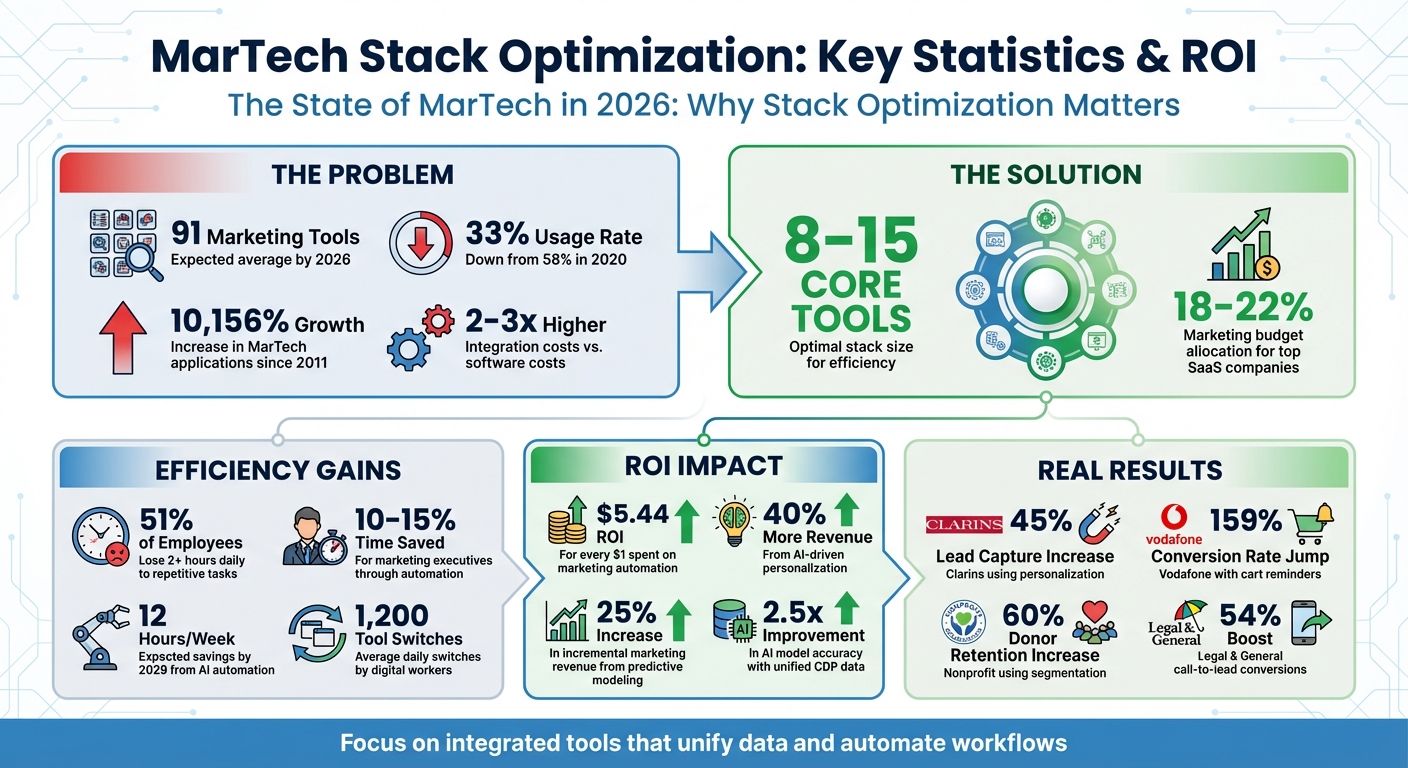
MarTech Stack Optimization: Key Statistics and ROI Metrics
EP 27: How to Build and Optimize Your Martech Stack
Predictive Analytics & Marketing Mix Modeling
When it comes to fine-tuning your MarTech stack, starting with tools that provide predictive insights is a smart move. Predictive analytics tools let marketers forecast what will genuinely boost revenue – before spending a single dollar. Instead of relying on outdated last-click attribution, modern platforms now use AI-powered Marketing Mix Modeling (MMM) to uncover the real connection between marketing investments and sales. This approach is a game-changer, as companies excelling in AI-driven personalization generate 40% more revenue from these efforts compared to their peers.
Platforms like Keen and Proof Analytics are leading the charge with advanced scenario modeling and regression analysis. For instance, Keen’s scenario modeling helps teams simulate budget allocations before launching campaigns, giving a clear picture of how each channel will impact revenue. Their data shows that using predictive modeling to allocate budgets effectively can result in a 25% increase in incremental marketing revenue. On the other hand, Proof Analytics uses automated regression analysis to pinpoint the exact marketing activities driving revenue. This allows marketers to identify and focus on the "20% of spend driving 80% of results".
Taking things further, top-tier platforms integrate CRM forecasting with real-time optimization. Tools like Salesforce Einstein and HubSpot AI bring pipeline forecasting and lead scoring right into your CRM, streamlining the process. Meanwhile, solutions like Northbeam specialize in multi-touch attribution, especially critical in the post-iOS 14 world. Platforms such as Optimove and 7th Sense go even deeper by analyzing behavioral patterns to predict customer journeys, enabling scaled, personalized messaging.
That said, the success of predictive analytics hinges on one key factor: data quality. Predictive models are only as good as the data they’re built on. Organizations that invest in a Customer Data Platform (CDP) to unify fragmented data see a 2.5x improvement in the accuracy of their AI-driven models compared to those stuck with siloed systems. Christine Dolce, Former Senior Digital Strategist at Acquia, emphasizes this point:
"Predictive analytics models are great, but they’re ultimately useless unless you can actually tie them to your day-to-day marketing campaigns".
For maximum impact, ensure that predictive tools integrate seamlessly with execution systems like ESPs, POS, and websites. Models that directly feed into campaign workflows outperform those relying on disconnected dashboards.
Marketing Automation & Email Platforms
Once predictive insights are in place, automation tools can take your marketing efficiency to the next level. These platforms handle personalized communication for massive contact lists with ease. And the payoff? Marketing automation delivers an average ROI of $5.44 for every dollar spent – often recovering costs in as little as six months [26,28,29]. By tying automation directly to predictive analytics, you can boost the overall performance of your MarTech stack.
Enterprise Solutions: Tools like Salesforce Marketing Cloud and Adobe Marketo Engage integrate with CRMs and CDPs to send AI-driven messages in real time [20,23]. For instance, Adobe Marketo Engage has earned a 4.3/5 rating on Gartner Peer Insights and was named a "Customers’ Choice 2025" for B2B marketing automation.
SMB-Friendly Tools: Platforms like HubSpot and ActiveCampaign deliver powerful features with user-friendly interfaces. ActiveCampaign, for example, offers over 900 customizable workflows, while HubSpot’s ecosystem boasts 1,200+ third-party integrations.
E-Commerce-Focused Tools: Klaviyo and Omnisend cater to online retailers by integrating seamlessly with Shopify. They automate revenue-generating workflows like abandoned cart recovery, which can convert 10.5% of lapsed shoppers.
The real-world impact of these platforms is undeniable. In 2024, beauty brand Clarins used Insider One’s Architect tool to create personalized cross-channel experiences. Over just 12 weeks, they saw a 45% increase in lead capture, a 4% rise in conversions, and an impressive 30x ROI. Vodafone also leveraged Insider One for on-site cart reminders, leading to a 159% jump in conversion rates.
Modern platforms are evolving even further with "AI Orchestration." Instead of simply suggesting actions, AI agents now execute tasks autonomously [24,25]. This shift is reshaping marketing – 77% of marketers now rely on AI-powered automation for personalized content, moving beyond basic templates to predictive engagement. As Shuai Guan, CEO of Thunderbit, aptly stated:
"In 2026, [marketing automation] is as essential as Wi-Fi".
When choosing a platform, consider your business’s size and specific needs. SMBs often prioritize affordability and simplicity – Brevo, for instance, offers a free plan with 300 daily emails, while paid plans start at just $8.08 per month [21,24]. Enterprises, on the other hand, require advanced features like robust security, GDPR or HIPAA compliance, and real-time data synchronization. Regardless of scale, selecting tools with native CRM or e-commerce integrations ensures unified customer data, keeping your MarTech stack running like a well-oiled machine [20,8].
Customer Relationship Management (CRM) & Analytics
A CRM is more than just a place to store contact information – it’s the backbone of your marketing data. By centralizing contact, company, and deal information, it creates a single, reliable source of truth. This eliminates the confusion and inefficiencies that come with juggling data across multiple platforms.
Modern CRMs go beyond simple demographic targeting with advanced segmentation capabilities. You can group audiences based on behavior, psychographics, or customer value. For instance, a mid-sized nonprofit that adopted segmentation saw donor retention climb by 60% and average gift sizes grow by 40%. Similarly, a SaaS company that used behavioral segments for personalized onboarding achieved a 25% boost in user activation rates.
When choosing a CRM, it’s important to align the platform with your team’s size and operational needs. Salesforce Sales Cloud offers extensive customization through its Data Cloud infrastructure and a large ecosystem of extensions, starting at $25 per user per month. For small to mid-sized businesses, HubSpot is a strong contender, thanks to its user-friendly interface and seamless two-way data syncing across over 1,200 integrations – including the marketing automation tools mentioned earlier. HubSpot plans start at $15 per user per month, with a solid free tier available. On the other hand, Zoho CRM stands out for its AI-powered "Zia" predictive analytics engine, with pricing beginning at $14 per user per month.
Regularly auditing your CRM is key to maintaining clean, actionable data. This includes eliminating redundant tools and standardizing elements like campaign names, UTM parameters, and lifecycle stages. Such consistency ensures accurate metrics like Sales Qualified Leads (SQLs), Customer Acquisition Cost (CAC), and Lifetime Value (LTV).
AI-powered automation is transforming how CRMs function. Tools like HubSpot Breeze and Salesforce Einstein now automatically enrich lead profiles with third-party data (e.g., company size, annual revenue), saving teams hours of manual work. These platforms also update audience segments in real time. A study highlighted that digital workers switch between tools nearly 1,200 times a day, making the CRM’s role as a centralized hub more critical than ever. These advancements not only streamline workflows but also enable comprehensive reporting and unified analytics across your entire marketing stack.
Data Management & Cloud Infrastructure
Marketing teams often juggle data spread across various tools – CRM systems, email platforms, social media, website analytics, and more. Without a reliable infrastructure, this scattered data creates silos, making it tough to form a complete picture of your customers. Cloud-based platforms address this challenge by consolidating data into a single source of truth – a centralized system that your entire team can access confidently. This unified structure is essential for leveraging advanced cloud and AI tools effectively in marketing.
Amazon Web Services (AWS) serves as a popular choice for building this foundation. Its S3 service handles large-scale object storage, while Redshift acts as a data warehouse capable of running complex queries. AWS operates on a pay-as-you-go model, allowing teams to scale costs based on fluctuating data needs throughout the year. Another option, Snowflake, separates computing power from storage, enabling users to scale processing as needed while keeping storage costs manageable. Snowflake’s flexibility extends to deployment on AWS, Google Cloud, and Microsoft Azure, helping teams avoid vendor lock-in.
To further streamline operations, tools like Segment act as a Customer Data Platform (CDP), pulling data from various sources – website visits, app interactions, email clicks, and purchase history – and transforming it into unified customer profiles in real time. This identity resolution happens before data reaches your warehouse, ensuring clean and actionable information from the outset. Segment offers a free tier for up to 1,000 visitors monthly, with paid plans starting at $120/month. For teams managing vast digital assets, Orange Logic (OrangeDAM) simplifies file management by offering unlimited storage on any cloud provider.
Modern infrastructures also integrate AI capabilities to enhance data management. AI tools can automatically tag metadata, summarize information in real time, and surface actionable insights. In fact, 77% of new MarTech tools introduced in 2024 were AI-native. This evolution is critical as marketing teams face increasing complexity – the number of MarTech applications has skyrocketed by 10,156% since 2011, yet usage rates have dropped from 58% in 2020 to just 33% in 2023. Cloud infrastructure helps cut through this complexity, ensuring that data remains accessible, unified, and ready for activation across all marketing channels.
When choosing infrastructure tools, integration capabilities should be a top priority. A data warehouse with robust APIs and webhooks ensures seamless connections with your marketing tools, preventing the creation of new silos. As Liam Boogar-Azoulay, former Head of Marketing at MadKudu, explains:
"Instead of ripping up a foundation it’s better to build something on top of it – a better roof, a better floor".
Strong integration ensures that predictive analytics, automation, and CRM systems work together harmoniously, creating a solid foundation that enhances every layer of your MarTech stack.
Data Quality & Observability
Even the best cloud infrastructure can’t perform well if the data running through it is flawed or incomplete. Marketing decisions hinge on accurate, reliable data – and that’s where observability tools step in. These tools act like quality control checkpoints, spotting errors before they disrupt campaigns or distort analytics. Let’s take a closer look at some tools that help maintain data quality and observability.
Twilio Segment is a go-to solution for ensuring data integrity. It validates and standardizes customer interactions before they reach your data warehouse. With more than 700 connectors, it helps verify customer identities and prevents fragmented records. This ensures that marketing automation tools operate with complete and accurate customer histories. Segment offers a free plan for up to 1,000 visitors per month, with Team plans starting at $120/month.
Compliance is just as critical as quality. Ketch simplifies privacy management by automating global consent requirements and handling data subject requests. It keeps your data collection aligned with regulations like GDPR, CCPA, and others that are constantly evolving.
When it comes to content quality, GPTZero acts as a watchdog for AI-generated copy. It detects non-original content and fixes grammar issues, ensuring your content maintains high standards.
Anomaly detection is another essential piece of the puzzle. Databox helps teams stay on track by allowing them to set specific goals and receive instant alerts when performance metrics – like email open rates or ad spend – stray from expectations. These real-time notifications make quick course corrections possible. Databox offers a free plan with three dashboards, while paid plans range from $59/month to $399/month.
Lastly, Usermaven tackles a common data accuracy problem caused by ad blockers. It captures interactions that traditional analytics tools might miss, delivering more reliable attribution data. Plus, it provides a 180-day lookback window, giving marketers a clearer picture of their campaigns’ impact.
Reporting, Analytics & Dashboards
Turning raw data into meaningful insights is key for marketing teams. Dashboards play a crucial role by transforming numbers into visual tools that highlight opportunities or flag issues before they grow. Here’s a look at some of the top tools that help marketers with real-time analytics and visualization.
Databox is a standout for its ease of use and versatility. It connects to over 100 data sources and includes more than 300 pre-built templates to track performance across marketing, sales, and support. A unique feature is its competitive benchmarking, which lets businesses compare metrics like bounce rate and visit duration directly with competitors. Databox offers a free plan with three dashboards, while paid plans range from $59/month to $999/month.
For teams needing more advanced customization, Klipfolio is a great choice. It supports over 30 chart types and allows users to filter data by specifics like channel, customer type, or location. This makes it ideal for businesses requiring highly tailored data views. Klipfolio offers a free plan, with the Standard plan priced at $300/month and Custom plans starting at $800/month.
Whatagraph simplifies grouping and blending data into real-time dashboards, which can be easily shared with stakeholders. Its Professional plan starts at $245/month (billed annually), while the Premium plan costs $492/month. For those already immersed in Google’s ecosystem, Google Looker Studio is a reliable free option, though it may require some time to master for beginners.
Another powerful tool, Supermetrics, integrates data from over 150 platforms and uses AI to summarize insights at a glance. This is particularly helpful for teams juggling campaigns across multiple channels, providing a unified view without manual work. For agencies, AgencyAnalytics offers white-label reporting and automated dashboard updates, starting at $12 per campaign per month, making it easy to deliver branded, automated reports.
These tools integrate smoothly with other components in a marketing stack, ensuring a data-driven approach that enhances both strategy and efficiency.
Digital Asset Management (DAM) & Workflow Consolidation
Managing digital assets effectively is a cornerstone of a well-structured MarTech stack. Digital Asset Management (DAM) platforms bring all brand assets under one roof, reducing confusion over versions and ensuring consistency across the board.
The DAM market is expected to hit $6 billion by 2025. Many modern DAM systems leverage AI to simplify tedious tasks. Features like auto-tagging, facial recognition, and natural language visual search help teams find what they need faster, leaving more time for creativity. For instance, Nuxeo can search through a staggering 1 billion assets in less than one-twentieth of a second. Canto, a leader in 2026, uses AI to speed up the entire content process, from brainstorming to distribution. MediaValet stands out for its unlimited user capacity and AI-powered search, making it ideal for video-heavy workflows. Meanwhile, Bynder specializes in global brand management, offering creative automation and secure brand portals. But a key factor to consider is how these platforms integrate with the tools you already use.
Integration is just as important as organization. DAM platforms that connect directly to creative tools like Adobe Creative Cloud, CMS systems like WordPress and Drupal, or marketing automation tools like HubSpot can eliminate the need for time-consuming manual file transfers. Omar Salem, a Web Technology Specialist at The Wallace Foundation, highlighted this benefit:
"One thing we love about the IntelligenceBank Drupal connector is the ability to select a preset without having to download an image or resize it. This connector streamlines the process and makes it quicker and easier to embed our full resolution, high-quality images."
DAM systems also help streamline workflows with features like built-in approval hubs and project management boards, cutting down on bottlenecks during campaign launches. Considering that teams often juggle 20–40 creative tools, consolidating these into a single platform reduces distractions and keeps everyone focused.
Pricing varies widely among DAM tools. For example, Cloudinary offers a free tier, and Pics.io allows small teams to use their existing Google Drive storage. Mid-sized teams often lean toward user-friendly options like Canto or Brandfolder, while large enterprises with complex needs may opt for Aprimo, which offers custom pricing for more advanced functionality. When choosing a DAM, look for platforms that offer native connectors for your existing tools and pricing models that can adapt as your organization grows. The right DAM can elevate both asset management and the efficiency of your MarTech stack.
Integration & Workflow Automation
Managing a marketing tech stack with 91 different cloud services can feel like juggling too many balls at once. That’s where integration and workflow automation tools step in, connecting the dots by automating the flow of data across platforms. This kind of connectivity helps create a seamless, automated workflow, improving efficiency across your entire system.
Here’s the difference: isolated automation tackles single tasks, but integrated automation links entire processes. For example, when a lead fills out a form, the data automatically updates in your CRM, assigns the lead to the right account manager, and launches an email sequence – all in one smooth motion. This eliminates delays and mismatched data, ensuring your marketing team can act quickly and accurately.
The impact of automation is hard to ignore. Did you know that 51% of employees lose at least two hours each day to repetitive tasks? Plus, marketing executives could automate 10–15% of their time. By 2029, AI-driven automation is expected to save up to 12 hours a week by reducing errors in tasks like lead-to-account matching and maintaining clean data.
Platforms like Workato, Tray.ai, Zapier, and Make make automation accessible with no-code interfaces for building workflows. Zapier alone connects over 8,000 apps, while Workato boasts a G2 score of 9.1. These tools also include essential features like role-based access controls and audit logs to keep your data secure.
Before diving into automation tools, it’s smart to take a step back and evaluate your current workflows. Map out your manual processes to identify bottlenecks and focus on high-friction tasks, such as audience segmentation or cross-platform reporting. And don’t forget – any new tool you choose should offer accessible APIs to ensure your data stays connected and cohesive.
1. HubSpot

HubSpot brings together CRM, automation, and analytics into a single platform. With businesses often juggling over 91 marketing tools, HubSpot’s unified system helps eliminate data silos and simplifies connectivity challenges.
Integration Capabilities
HubSpot offers more than 1,000 native integrations alongside a robust API, allowing businesses to connect with specialized tools without needing custom coding. For instance, pairing HubSpot with a Digital Asset Management system like Canto enables marketing and sales teams to access approved, on-brand assets directly within their CRM workflows. These native integrations help cut down integration costs, which can sometimes exceed software expenses by 2–3×. Additionally, HubSpot connects seamlessly with analytics and engagement tools, enabling real-time, personalized interactions.
Beyond its integration capabilities, HubSpot is designed to scale alongside growing businesses.
Scalability for Growing Businesses
HubSpot’s pricing structure caters to businesses of all sizes, starting with a free CRM tier and extending to Enterprise plans at $3,600/month for 10,000 marketing contacts. This tiered approach allows startups to build a centralized data system early on, while larger businesses can invest in advanced automation tools as they grow. The platform also enriches new contacts with third-party data, such as company size or annual revenue, reducing the time spent on manual research. As your business scales, you can add features like Account-Based Marketing (ABM) and predictive lead scoring without needing to migrate to a new platform.
Data Unification and Insights
Only 31% of marketers report being satisfied with their ability to unify data across their technology stack. HubSpot’s integrated design simplifies data management, optimizing your MarTech stack. Its contact timeline provides a chronological, 360-degree view of every interaction a lead has had, from form submissions to email opens. This gives sales teams critical context for more effective outreach. Additionally, closed-loop reporting connects marketing activities directly to revenue, helping you identify which campaigns generate deals – not just clicks.
Automation and Workflow Optimization
HubSpot minimizes manual tasks, boosting campaign efficiency through automation. Features like the unified contact timeline and drag-and-drop workflows make it easy for teams to track interactions and set up automated campaigns. The platform also includes AI-powered content assistance and pipeline forecasting to streamline content creation and sales predictions. For SaaS companies, HubSpot can monitor product usage data to trigger specific workflows, such as onboarding or upsell opportunities, based on user behavior.
2. Marketo Engage
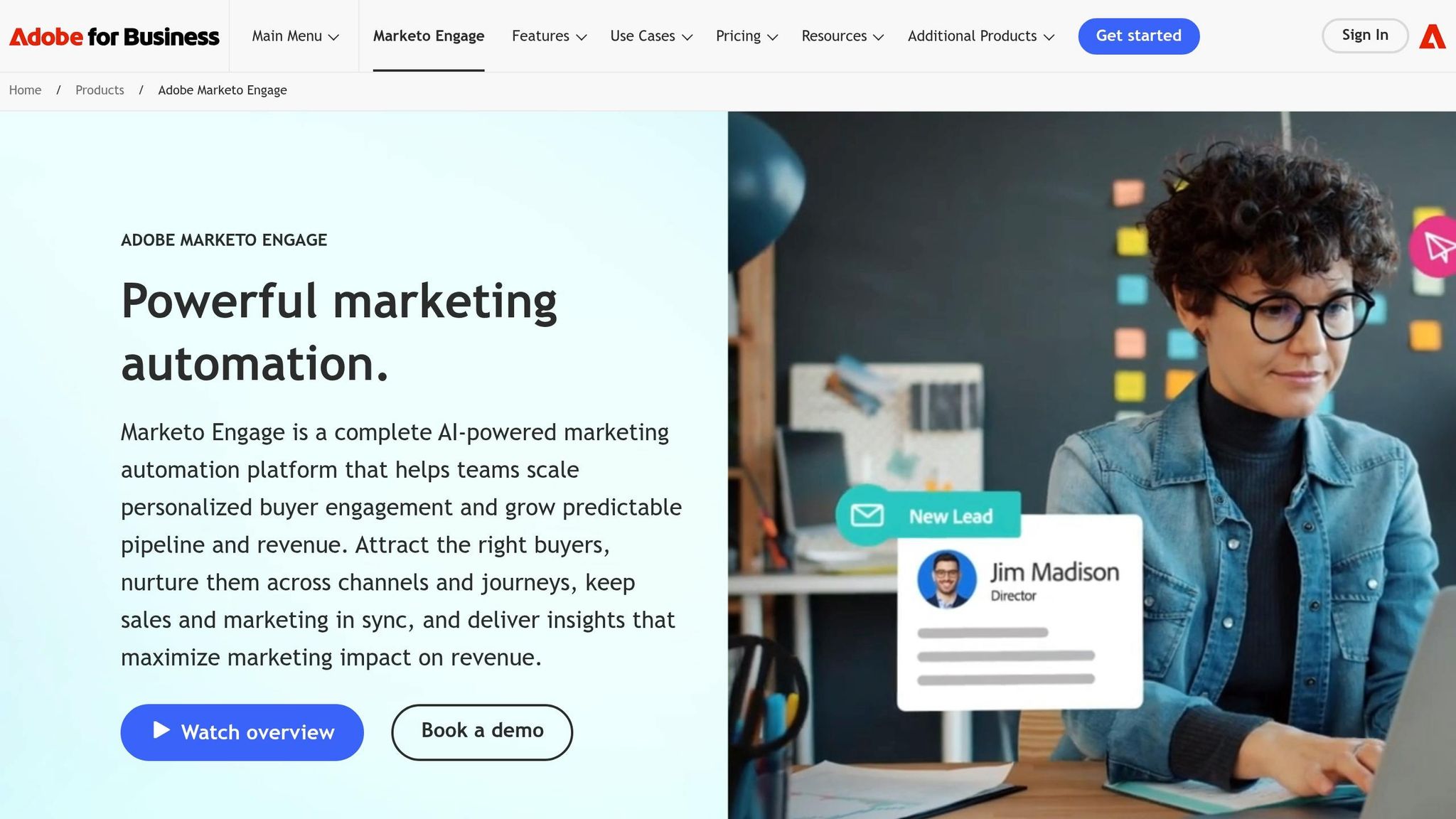
Marketo Engage is specifically designed for enterprise B2B companies dealing with complex sales cycles and advanced lead scoring needs. Unlike platforms like HubSpot, which often cater to smaller teams, Marketo serves as the backbone for marketing teams managing intricate buyer journeys and Account-Based Marketing (ABM) strategies. It highlights the importance of unified systems in streamlining your MarTech stack.
Integration Capabilities
Marketo boasts fast, two-way native synchronization with major CRM systems, including Salesforce, Microsoft Dynamics, and Veeva. It also connects seamlessly with Adobe Experience Cloud, integrating tools like Adobe Real-Time CDP for unified customer profiles and Adobe Analytics for behavioral insights. Additionally, it offers pre-built integrations with:
- Data enrichment tools like Clearbit and ZoomInfo
- Webinar platforms such as Zoom and ON24
- Workflow automation solutions via Zapier, enabling connections with over 8,000 applications
"It was very important for us to select marketing software that scaled quickly, could easily integrate with our other systems, and allow all of our marketers to become power users." – RingCentral
This extensive integration network makes Marketo a scalable and adaptable choice for enterprise needs.
Scalability for Growing Businesses
Marketo is built to grow alongside your business. Its tiered licensing options support expanding contact databases and high-volume campaigns, with the ability to handle up to 5 million email sends per hour at the highest tier. Many organizations transition to Marketo when their databases exceed 30,000 contacts or when the complexity of their campaigns requires more advanced automation tools.
Automation and Workflow Optimization
Marketo stands out with its advanced lead lifecycle management and pipeline acceleration, tailored for complex B2B sales processes. Features like progressive profiling on web forms can improve conversion rates by 30% to 50% compared to traditional methods. According to Adobe research, companies using Marketo see an average ROI of 267% compared to other marketing automation platforms.
While these powerful tools require dedicated operational support, the results can be transformative. For example, one company quadrupled its lead generation after integrating Marketo with Salesforce. This level of automation and optimization makes Marketo a vital asset for enterprise marketing teams aiming to scale effectively.
sbb-itb-edfb666
3. Salesforce Marketing Cloud
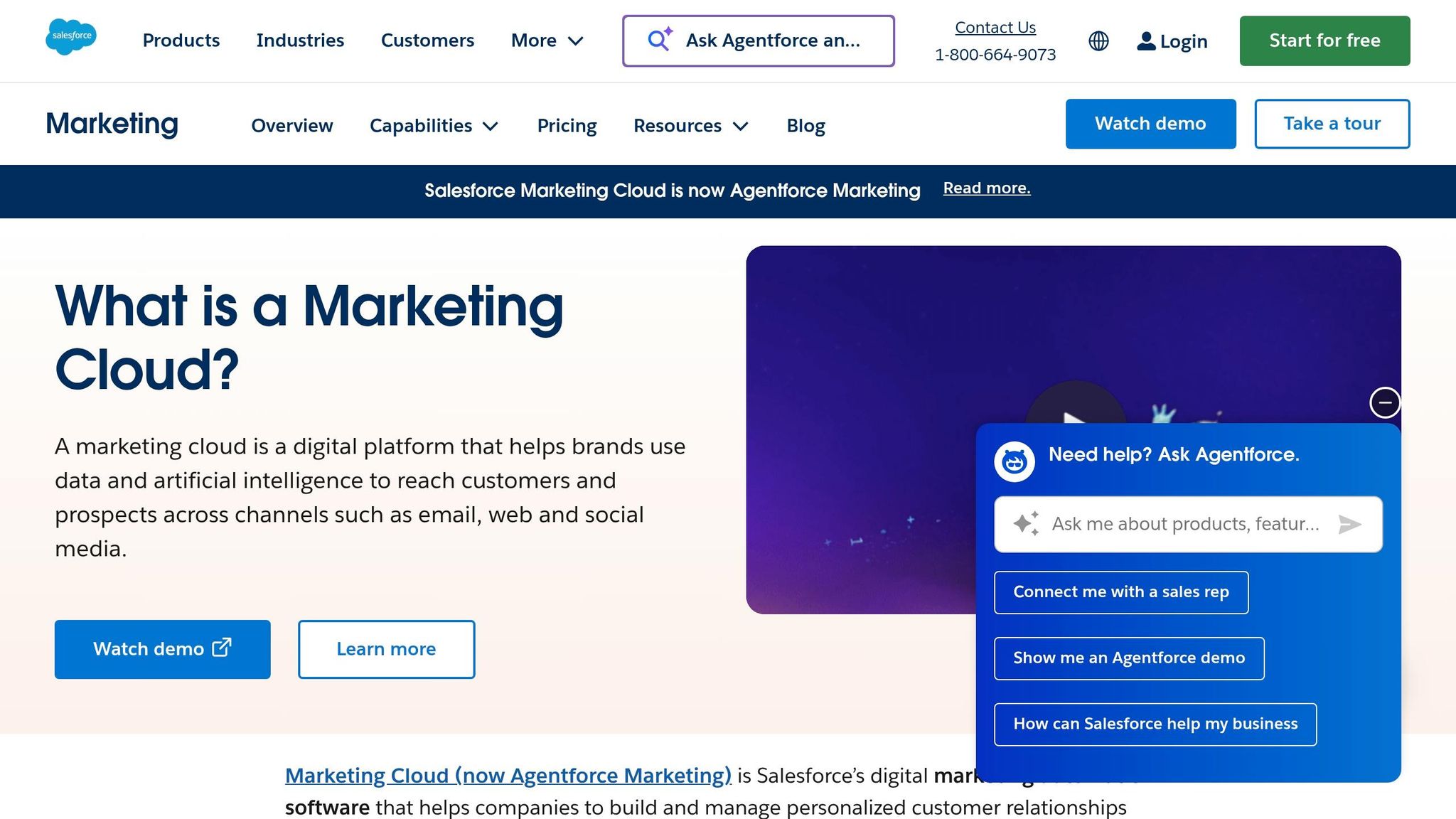
Salesforce Marketing Cloud is designed to manage large-scale, multi-channel campaigns. It integrates complex customer data from various sources and streamlines messaging across channels like email, SMS, mobile push, advertising, and WhatsApp. Impressively, it has held its position as a Leader in Gartner’s Magic Quadrant for Multichannel Marketing Hubs for eight consecutive years.
Integration Capabilities
Marketing Cloud Connect ensures seamless synchronization with Salesforce CRM, enabling smooth data sharing between sales and marketing teams [65,66]. For external systems, the MuleSoft Anypoint Platform simplifies data integration, while the AppExchange offers access to thousands of pre-built integrations [63,66,67]. A strategic partnership with Google Analytics 360 provides a direct link between web analytics and email or mobile performance, allowing automated customer journeys tailored to specific web audiences. Developers can also leverage Server-Side JavaScript (SSJS) and REST or SOAP APIs to trigger journeys based on external events [63,65]. These integration tools create a cohesive environment for a unified customer experience.
Data Unification and Insights
The platform’s Data Cloud (formerly Data 360) consolidates structured and unstructured data to create a single, comprehensive customer profile using identity resolution [62,66]. This unified data model powers Marketing Analytics, connecting campaign performance to revenue outcomes and offering insights into cross-channel customer behavior [64,66]. Businesses using Salesforce Marketing Cloud have seen a 32% boost in marketing ROI and a 34% increase in customer lifetime value. With this unified data structure, the platform enhances engagement through automation and deeper insights.
Automation and Workflow Optimization
Salesforce Marketing Cloud takes automation to the next level with tools designed to simplify complex workflows. Journey Builder provides a visual interface for mapping out multi-step customer paths that respond to real-time signals like abandoned carts, website activity, or purchase history [63,66]. Automation Studio supports backend tasks such as data imports, SQL queries, and audience segmentation, which can be triggered or scheduled as needed [63,68,70]. Additionally, Agentforce introduces AI-driven capabilities to segment audiences, create content, and facilitate two-way conversations across channels around the clock [62,66].
"The end of one-way marketing is here. With Agentforce embedded across email, SMS, and web, ‘do-not-reply’ messages become two-way customer conversations across channels and departments." – Salesforce Marketing Cloud
The platform’s impact is evident in real-world examples. RBC Wealth Management-U.S. drastically reduced client onboarding time from several weeks to just 24 minutes by automating case management workflows. Similarly, RecruitMilitary cut exhibitor event registration time from 30 minutes to just 30 seconds, saving over 4,000 hours of manual work in a single year.
4. Google Analytics 4

Google Analytics 4 (GA4) has become the go-to platform for tracking web and app performance since Universal Analytics ceased processing data on July 1, 2023. With 14.2 million websites worldwide and 3.2 million users in the United States, GA4 marks a major evolution in how businesses analyze customer behavior.
This platform builds on the themes of integration and automation, offering advanced tools for data export and unification to enhance your MarTech stack.
Integration Capabilities
GA4 stands out with its BigQuery integration, which allows businesses to export raw event and user data directly into BigQuery for deeper analysis. Setting up this integration is free, with storage costs averaging under $2 per month for properties managing up to 10 million events. GA4 also provides APIs for automation, including:
- Data API for custom reporting
- Admin API for configuration management
- Measurement Protocol for server-to-server tracking
Using the Google Cloud Cortex Framework, GA4 data can integrate into standardized marketing data models. Tools like Cloud Composer further automate workflows, making data handling more efficient.
Additionally, GA4 works seamlessly with Google’s advertising platforms, enabling businesses to export audiences and act on behavioral data in real time. For Firebase users, the SDK supports unlimited reporting for up to 500 events and integrates with Firebase Crashlytics and Remote Config for app management.
These integrations make GA4 a central player in delivering actionable marketing insights.
Data Unification and Insights
GA4’s event-based tracking system records every interaction – like clicks, scrolls, and downloads – as individual events, creating a unified view of customer activity across websites and mobile apps.
The platform identifies users across devices using a mix of methods, including User-ID (logged-in data), Google Signals (anonymized Google account data), Device ID, and behavioral modeling. Google Signals, for example, uses aggregated data from signed-in Google users to deduplicate interactions across devices, even if users aren’t logged into your site.
Built-in machine learning models further enhance GA4’s capabilities by providing predictive metrics such as purchase likelihood, churn risk, and expected revenue. These insights help businesses focus on high-value customer segments.
"Google Analytics is a new kind of property designed for the future of measurement: Collects both website and app data to better understand the customer journey." – Google
Sara Swaney, Director of Advancement at 412 Food Rescue, shared her experience:
"Google Analytics allows us to look at our data across platforms – web and app – to understand the full journey of our users. We’ve been able to cut our reporting time by 50%."
Scalability for Growing Businesses
GA4 offers scalability to meet the needs of businesses of all sizes. The free Standard GA4 version is sufficient for most, but the Analytics 360 enterprise tier is designed for companies with larger data requirements. Analytics 360 provides:
- Up to 125 custom dimensions
- 400 audiences
- 50 conversion types
- Unsampled explorations for up to 50 billion events per day
Enterprise users also benefit from near real-time data, with updates typically available within an hour. For global operations, sub-properties enable region-specific data views, while roll-up reporting combines metrics from multiple properties for a comprehensive overview.
One important note: enable BigQuery export as early as possible since it doesn’t backfill historical data. Delaying this step could mean losing valuable raw data for future analysis.
5. Segment
Segment is a powerhouse when it comes to connecting and organizing data across various tools in your tech stack. Acting as the "data plumbing" for your MarTech ecosystem, it gathers customer data from every interaction and directs it to the platforms that need it most. With SaaS companies in 2026 using an average of 91 marketing tools, Segment has become indispensable for keeping data consistent and accessible. By eliminating data silos and standardizing customer information, it ensures smooth operations across the board.
Integration Capabilities
Segment shines with its 400+ pre-built integrations, which link websites, mobile apps, and third-party platforms into one cohesive system. Its bi-directional data flow capabilities work seamlessly with tools like Snowflake, Amplitude, and Braze. Whether you’re a developer leveraging its flexible APIs or a marketer using its visual builder to design multi-channel campaigns, Segment caters to both technical and non-technical users.
Data Unification and Insights
One of Segment’s standout features is its real-time identity resolution, which ties customer actions across devices and platforms into a single, unified profile. This ensures that tools like your CRM, email software, and analytics platforms all work with the same up-to-date customer data, avoiding the pitfalls of fragmented information. Its ability to track behavioral events and product usage is particularly useful for teams focused on product-led growth. With this data, marketers can create precise customer segments and launch campaigns triggered by specific actions. In short, Segment’s capabilities grow alongside your business, ensuring your data remains actionable and reliable.
Scalability for Growing Businesses
Segment’s pricing model scales with your needs, offering options from a free tier to enterprise-level plans. As your data grows more complex, its identity resolution tools continue to maintain accurate customer profiles automatically. Plus, Segment eliminates the hassle of "integration debt" by providing a standardized way to connect new tools, so you won’t need custom code for every new addition. This makes it a future-proof choice for businesses of all sizes.
6. Zapier
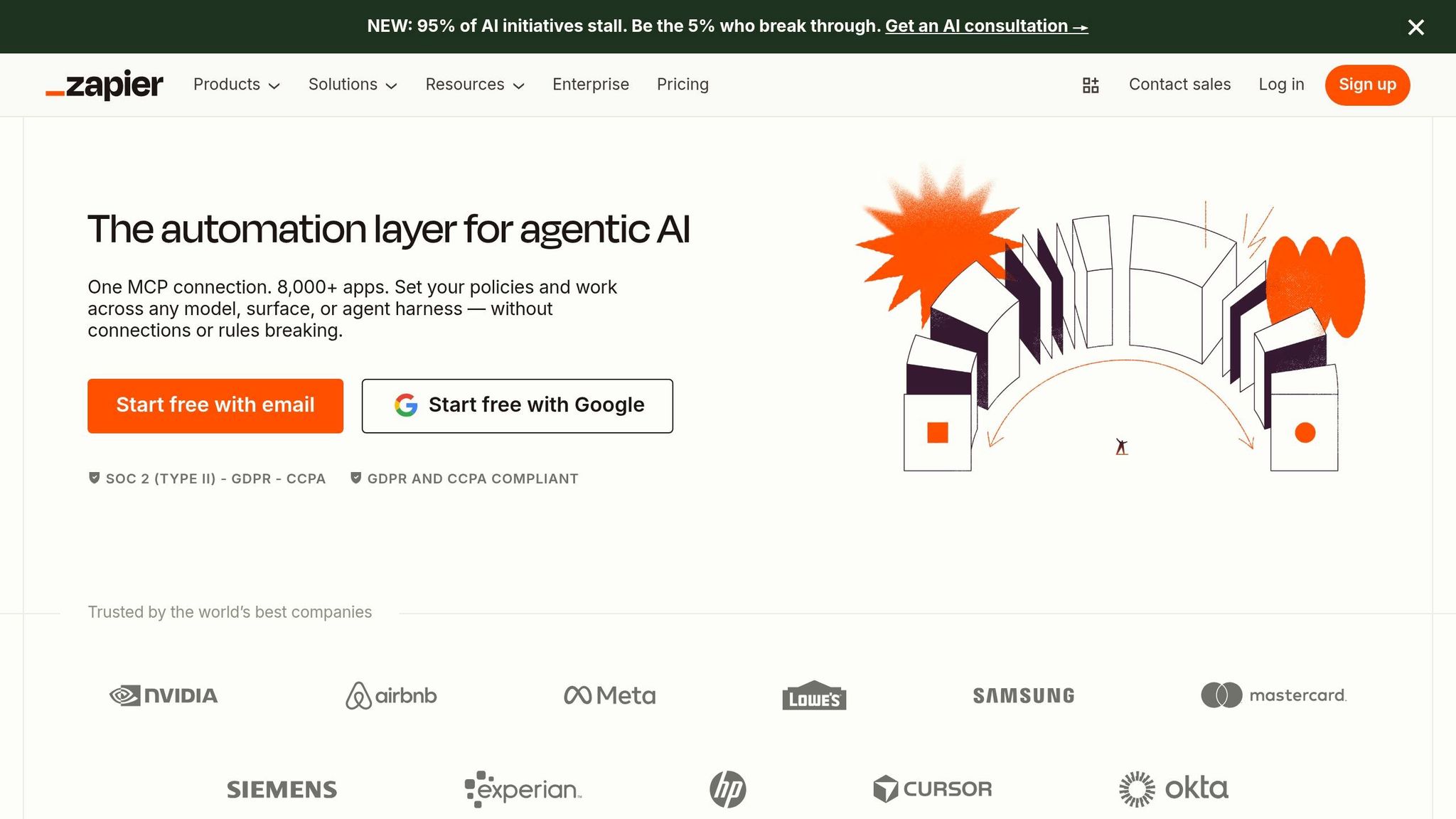
Zapier stands out as a key tool for streamlining your MarTech stack by automating workflows and connecting over 7,000 apps that typically don’t integrate directly. With marketers expected to juggle an average of 91 tools by 2026, the ability to automate processes without coding is becoming more important than ever. Zapier bridges the gap between disconnected platforms, enabling seamless data flow and eliminating the need for manual transfers.
Integration Capabilities
Zapier’s support for over 7,000 applications makes it a powerful solution for filling integration gaps that would otherwise require expensive custom development. Its "Zaps" – automated workflows triggered by specific events – simplify tasks like capturing lead information from a web form, scoring the lead based on behavior, and transferring data to your CRM and email systems. Features like Paths for conditional logic, Filters to refine automations, and Webhooks for custom integrations take its functionality even further.
For example, Toyota of Orlando’s Director of Operations, Spencer Siviglia, leveraged Zapier for AI-driven lead enrichment, managing over 30,000 lead records and saving his team more than 20 hours per week. These capabilities make Zapier a cornerstone for optimizing automation across your marketing ecosystem.
Automation and Workflow Optimization
Zapier doesn’t just integrate tools – it automates the entire lead lifecycle, from capturing leads to scoring them. The platform now processes over 1.5 billion tasks monthly, reflecting a 60% growth since 2023. Users can set up their first automation in under six minutes.
Companies are seeing tangible benefits from these automations. Calendly, for instance, saved 10 hours per week, while Hudl cut costs by $12,000 to $15,000 annually and reduced average handle time by 21.5%.
"Zapier allows us to send leads from Marketo to Salesforce via webhooks with extreme reliability and ease. Instead of spending hours and hours engineering a Salesforce sync to pull reports manually, we’re able to automate this."
– Micaela Wright, Associate Digital Marketing Manager
Scalability for Growing Businesses
Whether you’re a startup or a large enterprise, Zapier scales to meet your needs. Its tiered pricing plans grow with your business, ensuring your tools stay connected as you expand. The free tier includes 100 tasks per month, while the Professional plan starts at $19.99 per month (billed annually) and supports multi-step workflows. For larger organizations, enterprise plans offer unlimited users, advanced security features like Single Sign-On and VPC Peering, and dedicated support.
In 2025, Remote.com automated over 11 million tasks with Zapier’s enterprise-grade workflows, while Vendasta’s Jacob Sirrs reclaimed $1 million in pipeline and eliminated 282 days of manual work annually. With 99.9% uptime and over 10 million monthly active users, Zapier provides the reliable infrastructure businesses need for critical operations.
7. Snowflake
Snowflake is changing the game for marketing data management by bringing all your fragmented data together in one place. Instead of shuffling data across multiple platforms, Snowflake centralizes your applications and AI models where the data already lives. With over 11,100 active customers and integrations with more than 14,000 vendors, it’s become a key player for companies aiming to streamline their MarTech operations. By combining real-time insights with seamless integration, Snowflake offers a powerful solution for unifying and scaling your marketing stack.
Data Unification and Insights
Snowflake’s Data Clean Rooms allow you to collaborate on shared datasets with partners and agencies without exposing sensitive personal information. Meanwhile, its native AI tools – Snowflake Cortex and Snowpark – generate predictive insights without the need for data migration. Companies using these features have reported impressive results, such as 3x faster financial forecasting and saving thousands of dollars each month by optimizing their data workflows. These tools not only cut maintenance costs but also improve campaign flexibility, which is crucial for a well-oiled MarTech operation.
Take Legal & General, a UK financial organization, as an example. In September 2025, they integrated Tealium’s CDP with Snowflake’s AI Data Cloud, creating a two-way data flow that unified customer insights across marketing and call centers. The outcome? A 54% boost in call-to-lead conversions. Similarly, Spark New Zealand turned its marketing into a real-time, AI-driven powerhouse in 2024, generating millions in additional revenue through real-time audience orchestration.
Integration Capabilities
Snowflake’s Snowpipe Streaming API makes real-time data ingestion from platforms like Tealium a breeze. Plus, Reverse ETL tools push Snowflake data directly into CRMs and advertising platforms. The Snowflake Marketplace offers "zero-copy" data sharing, which means you can access third-party datasets and integrated applications without duplicating or moving data. This keeps everything secure while expanding your capabilities.
"Together, Tealium’s real-time data collection and audience orchestration, combined with Snowflake’s scalable AI Data Cloud, enable brands to activate privacy-first engagement across channels, without data silos slowing them down."
– Matthew Gray, SVP of Global Partnerships, Tealium
Scalability for Growing Businesses
Snowflake’s scalability makes it a great fit for businesses of all sizes. Its consumption-based pricing model ensures you only pay for the compute and storage you actually use. As your data needs grow, Snowflake scales automatically – no need for costly infrastructure upgrades. In 2025, the company reported a 32% year-over-year growth in product revenue, driven by demand for data infrastructure and AI workloads. Whether you’re handling 2 million customer records like Rohrman Auto Group or managing enterprise-level data flows, Snowflake adjusts to your needs while giving you the freedom to switch tools without being locked into a single vendor.
8. Tableau
As MarTech stacks grow increasingly complex with more data sources, Tableau stands out as a go-to platform for advanced visualizations and actionable insights. Owned by Salesforce, Tableau offers seamless integration with CRM data, making it easier to analyze pipeline health, revenue trends, and customer behavior. For businesses managing data from multiple sources, Tableau connects directly to cloud data warehouses like Snowflake, Amazon Redshift, and Google BigQuery. This means you can access real-time updates and handle complex queries on massive datasets without a hitch. Tableau’s ability to deliver timely insights ensures it complements other tools in your MarTech stack.
Data Unification and Insights
Tableau takes data analysis a step further with its Analytics Extensions API, which allows you to integrate Python (TabPy) and R for machine learning, predictive modeling, and "what-if" scenarios directly within your dashboards. For cleaning and merging datasets, Tableau Prep supports sources like Excel, SQL Server, and Oracle. However, it does have limitations, such as a 1GB file size cap and sampling up to 1 million rows at a time. For larger workflows, pairing Tableau with ETL tools like Fivetran or Airbyte is a smart move.
Integration Capabilities
What sets Tableau apart is its robust integration features. Beyond its native Salesforce connectivity, Tableau works with tools like Rollstack, automating the transfer of visualizations into PowerPoint and Google Slides – ideal for automating recurring reports like Quarterly Business Reviews. A common setup might include Alteryx for advanced data transformation, Snowflake for storage, and Tableau for visualization and sharing. To maintain consistent metrics across dashboards, integrating Tableau with dbt (Data Build Tool) ensures a single source of truth for key metrics like churn rate and revenue.
Scalability for Growing Businesses
Tableau offers flexible pricing and licensing to meet the needs of growing organizations. It’s typically adopted during the "Run" phase of MarTech maturity, when businesses require advanced Business Intelligence to consolidate data from numerous specialized tools. The Tableau Creator Plan costs $70 per user per month, billed annually at $840, and includes both Tableau Prep and Tableau Desktop. As your data requirements expand, Tableau’s API-first architecture ensures smooth communication between tools, helping to eliminate data silos – a common challenge for companies managing over 91 tools.
Looking ahead, Gartner predicts that by 2025, organizations using AI-powered tools like Tableau in their MarTech stacks will shift 75% of staff time from production tasks to strategic initiatives. This makes platforms like Tableau indispensable for businesses aiming to scale efficiently.
9. Bynder
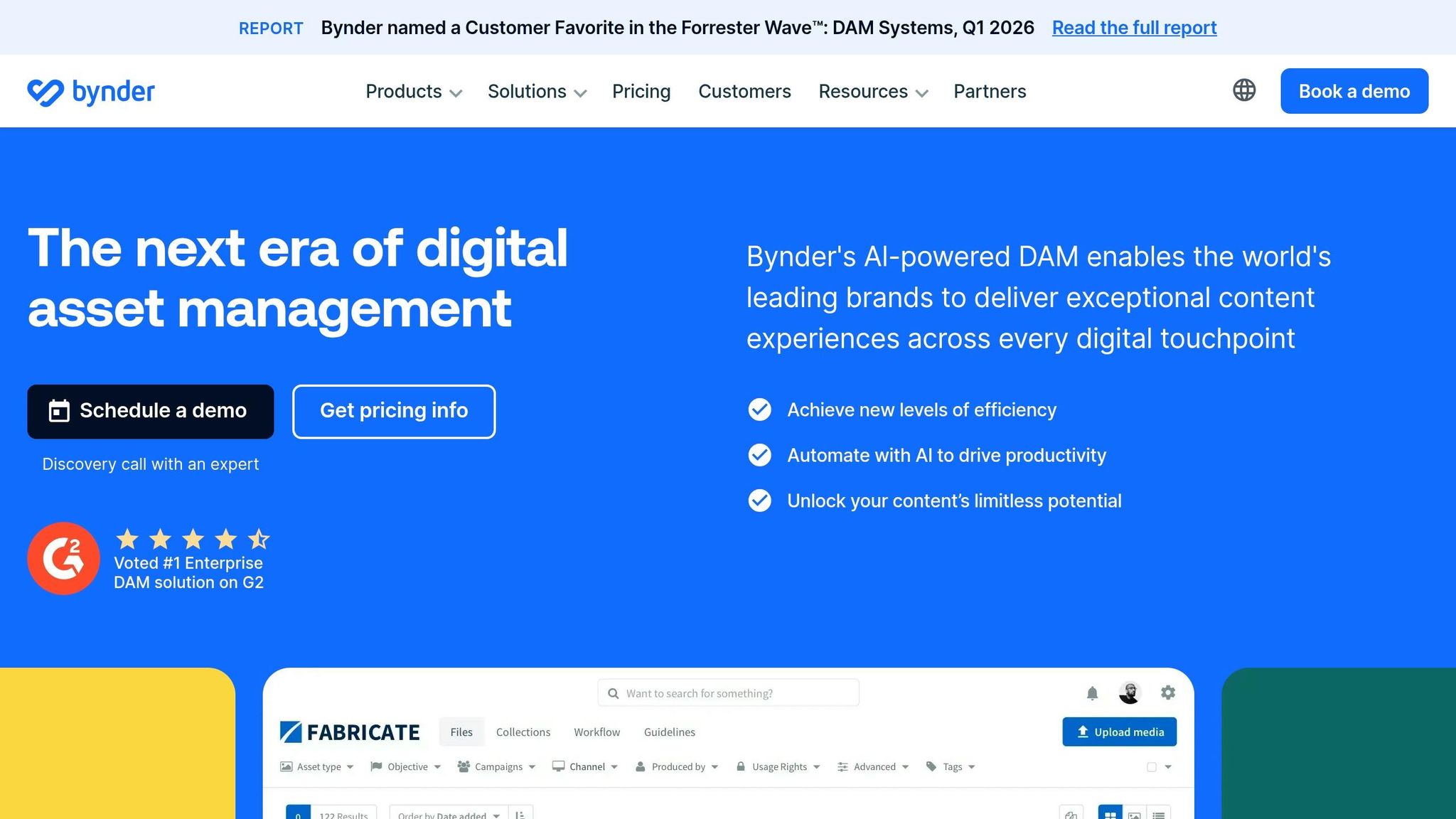
Bynder plays a crucial role in simplifying the management of brand assets within a well-organized MarTech stack. It acts as a Digital Asset Management (DAM) platform, ensuring marketing teams have easy access to the latest, brand-approved files. This eliminates the confusion caused by outdated logos, off-brand visuals, or duplicate content scattered across emails and shared drives. By centralizing assets, Bynder helps streamline campaigns and maintain consistency across all touchpoints. Recognized as a "Customer Favorite" in the Forrester Wave™: DAM Systems, Q1 2026, Bynder has become a go-to solution for businesses juggling complex marketing ecosystems.
Integration Capabilities
Bynder integrates effortlessly with a wide array of tools, making it a versatile choice for marketing and creative teams. It connects with creative platforms like Adobe Creative Cloud, Figma, Sketch, and Google Workspace, enabling designers to sync assets directly from their workspaces. For content management, it supports CMS platforms such as WordPress, Sitecore, and Optimizely. E-commerce systems like Shopify and SAP Commerce Cloud and marketing CRMs like Salesforce Marketing Cloud, Salesforce CRM, and HubSpot are also part of its integration network.
Project management becomes smoother thanks to connections with tools like Asana, monday.com, Wrike, and Smartsheet, which help reduce delays and automate asset handoffs. For businesses managing product catalogs, Bynder integrates with PIM systems such as Salsify and Akeneo to enhance assets with product metadata. The platform’s Compact View interface lets teams locate and import assets directly into third-party applications, minimizing the need for custom development and cutting down on implementation costs.
These integrations ensure smoother workflows and better collaboration across departments, paving the way for efficient asset management.
Automation and Workflow Optimization
Bynder’s Asset Workflow feature simplifies the approval process, ensuring only brand-compliant materials are distributed. Its CX for Omnichannel tool takes care of resizing, cropping, and formatting assets for various platforms like social media, email, and websites – completely automating what would otherwise be a time-consuming task. For global teams, Bynder Studio makes it easy to localize and create variations of print, digital, and video materials while still adhering to brand guidelines.
With its focus on automation and integration, Bynder helps marketing teams reduce inefficiencies and maintain a cohesive brand presence across all channels.
10. Kreativa Inc
While many MarTech tools zero in on automation and data management, Kreativa Inc takes a different route. They focus on bridging the talent gap that often prevents companies from fully utilizing their technology investments. Headquartered in Chicago, with operations in Mexico and Argentina, Kreativa offers nearshore staffing solutions. These solutions allow businesses to expand their marketing teams with highly skilled professionals – at nearly 50% less cost than hiring locally in the U.S. This approach helps companies fill crucial roles like marketing strategists, developers, and customer service specialists, complementing their tech investments by addressing skill shortages.
Flexible Growth for Expanding Companies
Kreativa’s nearshore model is built for businesses needing to scale quickly without the usual hiring challenges. Their talent pool operates in U.S. time zones and communicates fluently in English, ensuring smooth collaboration – no late-night calls or frustrating delays. Kreativa takes care of recruiting, onboarding, payroll, compliance, and HR management, freeing up internal teams to focus on strategic goals. For small to mid-sized businesses adopting composable architecture (building modular stacks), Kreativa provides the staffing flexibility to implement new capabilities 60% faster while cutting total ownership costs by 40%.
Integrating Talent with Technology
Optimizing MarTech isn’t just about connecting tools; it’s about combining them with the right expertise to drive results. Kreativa embeds skilled professionals directly into client teams, ensuring smooth automation, efficient lead management, and actionable customer insights. Their approach prioritizes impactful data flows over flawless technical synchronization – addressing a common challenge for companies that rely solely on software solutions. By blending expert talent with technology, Kreativa enhances the overall efficiency of marketing stacks.
Comparison Table
Navigating the MarTech landscape can feel overwhelming, but understanding how tools like Segment, Tableau, and Snowflake differ can help you build a well-integrated system. Below is a breakdown of their main functions, integration capabilities, and pricing.
| Feature | Twilio Segment | Tableau | Snowflake |
|---|---|---|---|
| Primary Function | Customer Data Platform (CDP) | Data Analytics & Visualization | Data Warehouse & Cloud Infrastructure |
| Integration Strength | 700+ pre-built connectors and a robust API ecosystem | API-driven data preparation and interactive dashboards | Centralized "System of Record" for cross-departmental data |
| Best For | Real-time data routing and identity resolution | Creating detailed visual reports and analyzing data | Managing and scaling large datasets |
| Pricing Model | Usage-based | Subscription-based | Enterprise/Usage-based (Infrastructure) |
Each platform plays a distinct role in creating a seamless MarTech stack. Segment acts as the connective tissue, routing real-time behavioral and profile data through its extensive network of connectors. Tableau transforms raw data into actionable insights with interactive dashboards that can handle datasets far beyond Excel’s limits. Meanwhile, Snowflake centralizes data storage and separates computing from storage, allowing workloads to scale independently across popular cloud platforms like AWS, Azure, and Google Cloud.
A survey shows that about 38% of marketing professionals prioritize tools that integrate smoothly with their existing systems. This makes compatibility a key consideration. For instance, Segment feeds clean, structured data into analytics tools like Tableau, which can directly query Snowflake’s semantic views to maintain consistent business logic.
Pricing models also vary widely. Segment charges based on event volume and the number of destinations connected. Tableau typically offers tiered subscription plans, while Snowflake’s costs depend on storage and processing usage. Beyond these fees, you should also plan for implementation expenses, consulting services, and ongoing maintenance – especially for enterprise-level solutions like these.
This table highlights how these platforms complement each other, ensuring a streamlined and efficient MarTech stack.
Conclusion
Building an efficient MarTech stack is all about focusing on a handful of integrated tools that deliver measurable results. While the average SaaS company uses over 91 marketing tools, the most effective teams narrow it down to around 8–15 core platforms. These tools work together seamlessly, cutting through the noise and driving real ROI.
"Your marketing tech stack is either your unfair advantage… or the reason everyone on your team spends half their day wrestling with tools".
Choosing tools wisely ensures that each one adds value instead of creating unnecessary complexity.
Streamlining your stack to 8–15 platforms can significantly reduce integration costs, which often run 2–3 times higher than the tools themselves. Plus, a well-integrated system eliminates data silos, turning your tools into a single "system of record" that offers clear insights into performance.
Top-performing SaaS companies typically allocate 18–22% of their marketing budget to tools that reduce manual tasks, scale output efficiently, and align with how teams actually work. Before adding another tool to your lineup, take stock of your current setup. Check for native integrations, and evaluate how each tool impacts key metrics like cost per acquisition and customer lifetime value.
When done right, your MarTech stack becomes a competitive edge. By bringing creativity, content, and customer data into a unified system, you can focus on strategy instead of struggling with software. This kind of integration allows you to scale smarter, not harder, keeping costs in check while driving growth.
FAQs
How do I decide which tools to keep vs. cut?
To keep your MarTech stack running smoothly and delivering results, it’s essential to regularly assess each tool’s integration, effectiveness, and alignment with your marketing objectives.
Start by identifying tools that fit seamlessly into your existing systems. These should support key functions like lead generation, analytics, or campaign management while delivering measurable outcomes. If a tool integrates well and actively contributes to your goals, it’s worth keeping.
On the flip side, eliminate tools that create redundancies, disrupt workflows, or fail to provide strategic value. Overlapping features or underperforming software can lead to inefficiencies and wasted resources.
Make a habit of conducting regular audits. Check for factors like cost-effectiveness, performance, and relevance to your current strategy. This ensures your stack remains lean, efficient, and aligned with your goals.
What’s the best order to optimize a MarTech stack?
To get the most out of your MarTech stack, start by focusing on the basics. A CRM (Customer Relationship Management) system is a great starting point – it helps centralize customer data and automate essential tasks. Once that’s in place, bring in tools for data unification to keep information consistent across all platforms.
Next, layer in automation and analytics tools. These can simplify campaign management and provide actionable insights to refine your strategies. As your needs grow, you can add specialized tools for things like content management or attribution tracking. The key is to prioritize tools that integrate well, automate processes, and deliver measurable results.
When should I add nearshore MarTech talent from Kreativa Inc?
If you’re looking to scale your marketing technology team quickly and affordably, consider tapping into nearshore MarTech talent through Kreativa Inc. This approach is particularly helpful during times of rapid growth, major product launches, or when tackling complex projects that demand smooth collaboration across time zones. Kreativa ensures cultural alignment and minimizes communication barriers, making teamwork seamless. Plus, they take care of recruiting, onboarding, and compliance, so you can stay focused on strategy without compromising on quality or efficiency.